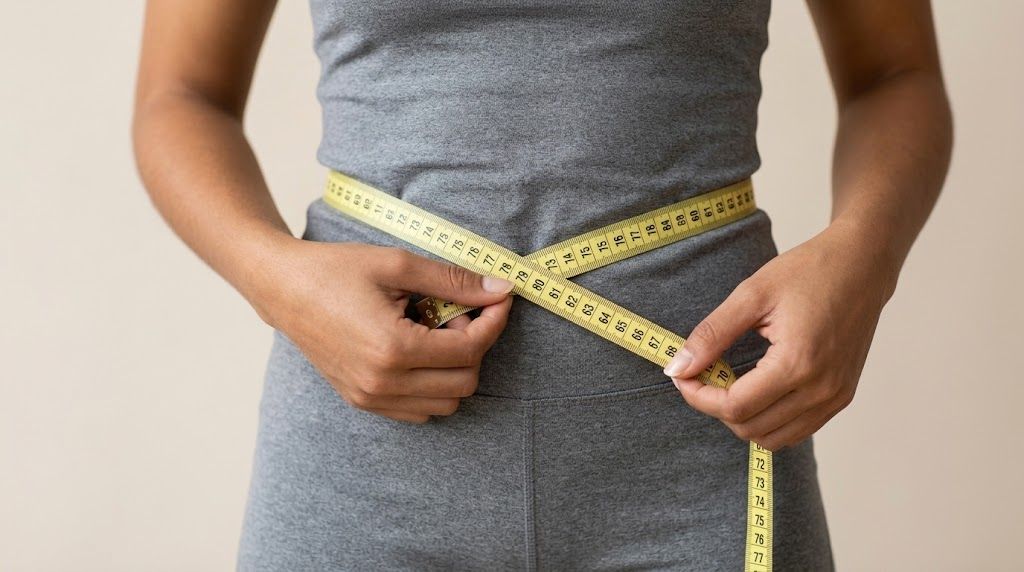
Central fatness mortality risk is shaped not by how much you weigh, but by where your fat sits on your body. A landmark 2020 meta-analysis published in The BMJ, pooling data from 72 prospective cohort studies and more than 2.5 million participants, confirmed that waist circumference, waist-to-hip ratio, and waist-to-height ratio each predict all-cause mortality independently of body mass index. For readers in Saudi Arabia and the Gulf — where obesity prevalence has risen sharply alongside rapid urbanisation and dietary change — these findings carry a direct, practical message: a tape measure around the waist may tell you more about your long-term health risk than any bathroom scale. Understanding how waist-to-height ratio outperforms BMI is a closely related finding from the same body of research.
The Scale of the Evidence
Researchers led by Ahmad Jayedi screened nearly 99,000 published studies, reviewed close to 2,000 in full, and combined data from 72 prospective cohort studies tracking a combined 2,528,297 adults. The analysis examined eight separate measures of central or abdominal fatness: waist circumference, hip circumference, thigh circumference, waist-to-hip ratio, waist-to-height ratio, waist-to-thigh ratio, body adiposity index, and A Body Shape Index. Crucially, every association was adjusted for BMI throughout, meaning the results reflect the effect of fat distribution independent of overall body size — not simply a proxy for being heavier. This is one of the largest and most rigorous analyses ever conducted on body fat distribution and mortality risk, and it forms part of the broader evidence base explored across our diabetes and diet resource hub.
What the Numbers Show About Central Fatness Mortality
The results were consistent and precise. Every 10-centimetre increase in waist circumference was associated with an 11% higher risk of death from any cause. Waist-to-hip ratio showed an even stronger association: every 0.1-unit increase corresponded to a 20% higher mortality risk. Waist-to-height ratio showed a 24% higher risk per 0.1-unit increase. All three associations held after accounting for BMI, confirming that central fatness carries meaningful, independent risk information beyond total body weight.
These findings align with the World Health Organization’s recognition that waist circumference is a practical tool for identifying people at elevated risk of metabolic complications, even when BMI falls within the “normal” range. The WHO notes that higher-than-optimal BMI caused an estimated 3.7 million deaths globally in 2023, largely through cardiovascular disease, diabetes, and cancers — conditions closely linked to visceral fat accumulation.
The Protective Role of Hips and Thighs
Perhaps the most striking finding is that hip and thigh circumference moved in the opposite direction. Every 10-centimetre increase in hip circumference was associated with a 10% lower risk of death, and every 5-centimetre increase in thigh circumference was linked to an 18% lower risk. In other words, fat and muscle carried on the hips and thighs appear to be protective rather than harmful — a sharp contrast to waist-based measures. This helps explain why a “pear” body shape, with fat distributed more toward the hips and thighs, is consistently associated with better outcomes than an “apple” shape, where fat concentrates around the abdomen, even at identical overall weight.
Why Abdominal Fat Carries More Risk
The likely explanation lies in the type of fat found in each location. Fat around the abdomen tends to include a higher proportion of visceral fat — stored around internal organs rather than beneath the skin — which is metabolically active in ways that contribute to insulin resistance, chronic low-grade inflammation, and cardiovascular strain. Fat carried on the hips and thighs, by contrast, is predominantly subcutaneous fat, which appears comparatively metabolically benign and may even help regulate blood sugar and lipid levels favourably. This distinction is part of why two people at the same BMI can have meaningfully different health risk profiles depending on where their body stores fat.
For men and women in Saudi Arabia, where rates of type 2 diabetes and cardiovascular disease are among the highest in the world, this distinction matters. Visceral fat accumulation is closely linked to the metabolic syndrome cluster — elevated blood glucose, high blood pressure, abnormal lipids — that drives much of the region’s chronic disease burden.
Measuring Your Waist Circumference
Unlike some health metrics, this one requires no special equipment — just a flexible tape measure. Stand relaxed, locate the top of your hip bone and the bottom of your rib cage, and measure around your waist at the midpoint between the two, keeping the tape snug but not compressing the skin, after a normal exhale. Commonly cited risk thresholds are a waist circumference above roughly 94 cm for men and 80 cm for women, with substantially elevated risk above about 102 cm and 88 cm respectively. These are population-level reference points, not individual diagnoses, and should be interpreted alongside overall health context rather than in isolation.
Practical Takeaways
- BMI alone does not tell the full story: two people with identical BMI can carry meaningfully different central fatness mortality risk depending on where their fat is distributed — waist measurement adds real, independent information.
- Waist circumference is simple and useful: unlike more complex body composition tools, it requires only a tape measure and takes seconds, making it easy to monitor over time.
- Reducing abdominal fat specifically matters: aerobic exercise and resistance training both show consistent evidence of preferentially reducing visceral abdominal fat, even when total weight change is modest.
- Do not worry about hip or thigh size: this research suggests fuller hips and thighs are not a health liability — in fact, quite the opposite — so the focus for risk reduction should be specifically on the waist.
- Combine with other health markers: waist circumference is one useful data point among several — pairing it with measures like blood pressure, fasting glucose, and lipid profile gives a fuller picture than any single number alone.
Sources
- Jayedi A, Soltani S, Zargar MS, Khan TA, Shab-Bidar S. Central fatness and risk of all cause mortality: systematic review and dose-response meta-analysis of 72 prospective cohort studies. BMJ. 2020;370:m3324.
- World Health Organization. Obesity and overweight: fact sheet. Updated October 2026.
The information in this article is for educational purposes only and does not replace professional medical advice.
The Active Arabia weekly
One article built on one named study, every week, in your inbox. No noise.
We never share your email. Unsubscribe in one click.