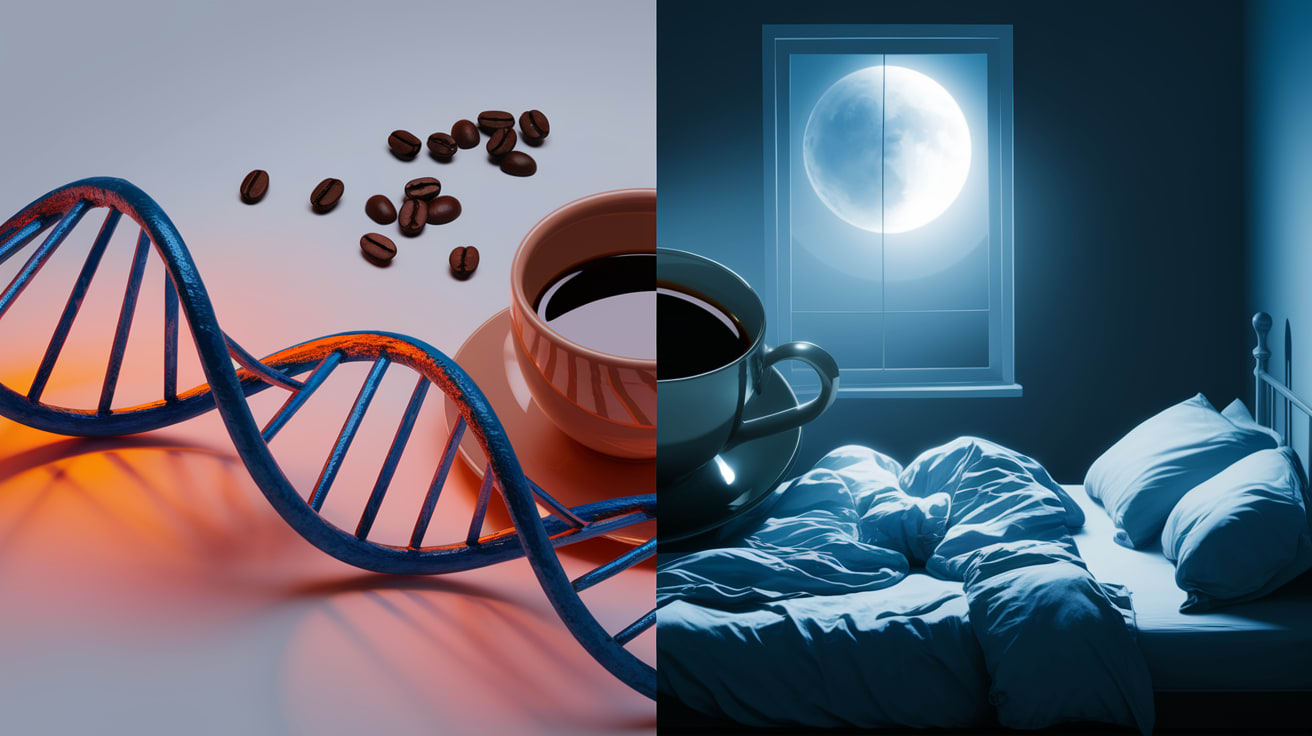
Understanding caffeine metabolism genetics explains why some people can drink coffee after dinner and sleep soundly, while others toss and turn after a single afternoon cup. The answer isn’t willpower — it’s your DNA. Research shows that genetic variations in the CYP1A2 liver enzyme determine how quickly your body breaks down caffeine, directly affecting your sleep quality and overall health. In this article, we break down the latest numbers and scientific discoveries on this fascinating topic.
According to a comprehensive review published in Psychopharmacology by Yang and colleagues at the University of Chicago in 2010, the heritability of caffeine-related traits ranges between 0.36 and 0.58, meaning genetics can explain up to 58% of the variation in how our bodies respond to caffeine. This isn’t anecdotal — it’s hard science backed by twin studies and genome-wide association research.
The science of caffeine metabolism genetics: How the CYP1A2 enzyme works
Caffeine is primarily metabolized in the liver through the cytochrome P450 enzyme system, specifically the enzyme called CYP1A2. This enzyme converts caffeine into three dimethylxanthine compounds: paraxanthine, theobromine, and theophylline, each with distinct effects on the body. Paraxanthine is the most abundant and contributes to caffeine’s stimulant effects, while theobromine affects blood vessels and theophylline affects airways.
According to the StatPearls medical reference published by the U.S. National Institutes of Health (NIH) and updated by Evans and colleagues in 2024, the half-life of caffeine in an average healthy adult is approximately 5 hours. But this number hides enormous variation that depends heavily on caffeine metabolism genetics: smokers eliminate caffeine up to 50% faster due to CYP1A2 enzyme induction. Meanwhile, pregnant patients in their final trimester may experience a half-life of up to 15 full hours due to hormonal changes that slow the enzyme. Premature newborns can have half-lives reaching 100 hours due to immature liver enzymes and underdeveloped demethylation pathways.
This is where caffeine metabolism genetics plays its critical role: people who carry the fast variant of the CYP1A2 gene (known as *1A) produce a more efficient and active enzyme, so caffeine breaks down rapidly in their bodies. Others carry a slow variant (such as *1F), meaning caffeine lingers in their bloodstream for much longer, increasing the likelihood of sleep disruption and anxiety.
Caffeine Metabolism Genetics and the Shocking Sleep Numbers
The numbers are striking and deserve close attention. According to data from approximately 160,000 Sleep Foundation profiles, roughly 88% of people who regularly consume caffeine in the afternoon have reported at least one sleep problem. That’s not a small fraction — it’s nearly everyone who drinks coffee after noon.
In a landmark study published in the Journal of Clinical Sleep Medicine in 2013 by Drake and colleagues, caffeine consumed even 6 hours before bedtime significantly reduced total sleep time by more than one full hour. This means that cup of coffee you drink at 4 PM may still be affecting you when 10 PM arrives.
More importantly, studies suggest that caffeine reduces slow-wave sleep — the deepest stage of sleep responsible for feeling refreshed and recovered the next day. Even if you can fall asleep after drinking coffee, you may not be getting the deep, restorative sleep your body needs for cellular repair and recovery. This explains why some people feel tired even after apparently sleeping for a sufficient duration.
Genes and Insomnia: Why Are Some People More Vulnerable?
It’s not just about how fast you metabolize caffeine — caffeine metabolism genetics interacts with other genes to shape your complete experience with coffee. Genetic studies have linked variations in the ADORA2A gene — which encodes the A2a adenosine receptor in the brain — to caffeine-induced anxiety and sleep disturbances. When caffeine blocks adenosine receptors, it promotes wakefulness and alertness, but variations in this gene make some brains more sensitive to this stimulating effect.
This explains what researchers call the “caffeine paradox”: two people drink the same amount of coffee at the same time, but one sleeps soundly while the other stares at the ceiling all night. The difference isn’t habit or tolerance — it’s DNA and neural receptor composition.
A 2026 study by Todorovic published in Sports Medicine further indicates that CYP1A2 genetic polymorphisms influence not only caffeine metabolism and sleep sensitivity but also athletic response and physical performance, adding another dimension to why understanding your genetic makeup matters. Additionally, a study by Çalışkan in Coffee Science and Biotechnology describes the so-called “caffeine paradox” where genetic variations in CYP1A2 and AHR interact to determine your unique experience with caffeine.
How Much Caffeine Is Safe? Numbers You Should Know
The U.S. Food and Drug Administration (FDA) recommends that up to 400 milligrams per day is generally safe for adults — roughly equivalent to 4 cups of regular brewed coffee. But this number is a general guideline that doesn’t account for individual differences in caffeine metabolism genetics. A slow metabolizer may be negatively affected by a much smaller amount.
Here are some useful figures to help you understand how much caffeine you’re consuming:
- One cup of brewed coffee (8 oz / 240 ml): 100-200 milligrams of caffeine depending on bean type and brewing method
- Energy drink (8-16 oz / 240-480 ml): 50-300 milligrams depending on brand
- Soda (12 oz / 360 ml): 0-70 milligrams
- Black or green tea (8 oz / 240 ml): 40-120 milligrams
- Toxic dose: approximately 1.2 grams can cause serious symptoms including rapid heartbeat and tremors
- Life-threatening dose: estimated between 10-14 grams based on recorded poisoning cases
The general recommendation is to stop consuming caffeine at least 8 hours before bedtime. But if you carry the slow variant of the CYP1A2 gene, you may need a longer window — perhaps 10 hours or more — to ensure your sleep isn’t affected.
What Can You Do? Practical Takeaways Based on Science
- Track your caffeine timing: If you struggle with sleep, try cutting off caffeine after 2 PM as a general rule
- Keep a sleep diary: Record when you drink coffee and how well you sleep to discover your personal patterns and understand how your body responds
- Reduce caffeine gradually: Quitting cold turkey causes withdrawal symptoms including headaches, anxiety, and irritability, lasting up to a week
- Replace evening coffee with healthy alternatives: Morning natural light exposure, regular exercise, and better sleep hygiene can boost your energy naturally without caffeine
- If you’re pregnant: Remember that caffeine’s half-life reaches up to 15 hours in the final trimester, and the safe limit is 200 mg daily per the American College of Obstetricians and Gynecologists (ACOG)
- Watch for drug interactions: The CYP1A2 enzyme also metabolizes many medications including certain antidepressants, so consult your doctor if you take regular medications
The Bottom Line: Your Genes Aren’t Your Destiny — But They’re Your Guide
Caffeine metabolism genetics doesn’t deterministically dictate your health destiny, but it offers a compelling scientific explanation for why your experience with coffee differs from others. If you’re a “slow metabolizer,” that doesn’t mean you must give up coffee entirely — it means you need to be smarter about timing your consumption and respect the signals your body sends you.
The science is clear and direct: understanding how your body handles caffeine at the genetic level can be the first step toward better sleep and deeper health. And the numbers don’t lie — when 88% of afternoon caffeine consumers report sleep problems, it may be time to listen to what your body is telling you and make decisions based on science rather than habit.
Sources
- Evans J, Richards JR, Battisti AS. Caffeine. StatPearls [Internet]. Treasure Island (FL): StatPearls Publishing; 2024. https://www.ncbi.nlm.nih.gov/books/NBK519490/
- Yang A, Palmer AA, de Wit H. Genetics of caffeine consumption and responses to caffeine. Psychopharmacology (Berl). 2010;211(3):245-57. https://pubmed.ncbi.nlm.nih.gov/20532872/
- Drake C, Roehrs T, Shambroom J, Roth T. Caffeine effects on sleep taken 0, 3, or 6 hours before going to bed. J Clin Sleep Med. 2013;9(11):1195-1200. https://pubmed.ncbi.nlm.nih.gov/24235903/
- Sleep Foundation. Caffeine and Sleep. Updated July 2025. https://www.sleepfoundation.org/sleep-hygiene/caffeine-and-sleep
Disclaimer: This article is for educational purposes only and does not constitute medical advice. The information provided is not intended to replace professional medical consultation, diagnosis, or treatment. Always consult a healthcare provider before making changes to your diet or habits.
The Active Arabia weekly
One article built on one named study, every week, in your inbox. No noise.
We never share your email. Unsubscribe in one click.