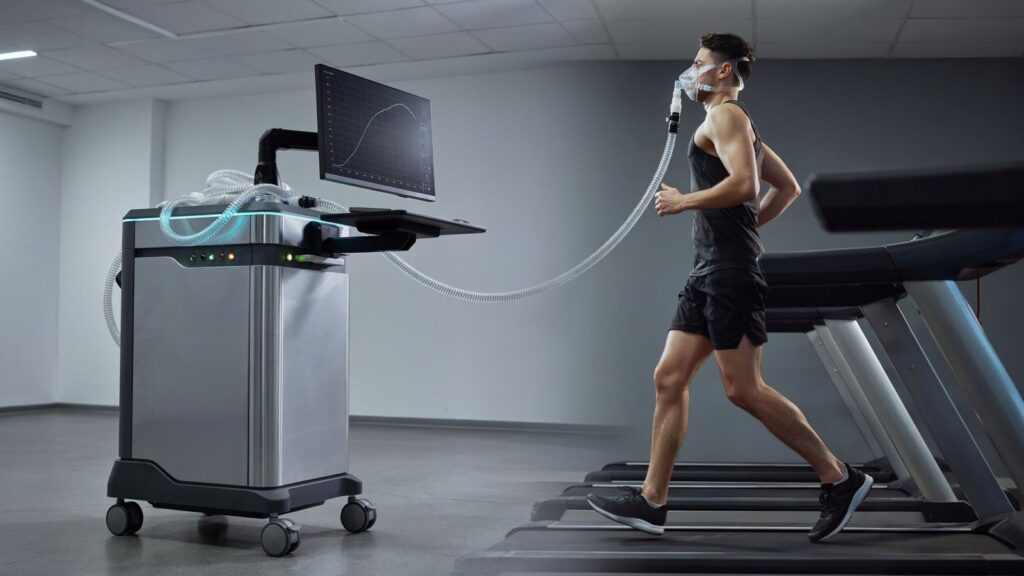
When Kristian Blummenfelt VO2max test results appeared on Instagram in late January 2026, showing a reading of 101.1 mL/kg/min, the endurance sports world reacted with a mix of awe and skepticism. The Tokyo Olympic gold medalist and multiple Ironman world champion had seemingly become the first person to break 100 — but leading physiologists quickly questioned whether the number was real. The debate touched on fundamental questions about testing protocols, equipment calibration, and how we interpret extreme physiological data. For more on how aerobic fitness relates to long-term health, see our guide to strength and ageing.
What VO2max Actually Measures
VO2max is widely considered the gold-standard indicator of aerobic fitness — the maximum volume of oxygen your body can take in, transport, and use per minute, per kilogram of body weight, during maximal exertion. It reflects the combined capacity of your lungs, heart, blood, and muscles working together, and it is strongly linked to both athletic performance and long-term health. Research consistently associates higher VO2max values with lower all-cause mortality risk, making it one of the most robust predictors of longevity in exercise science, as explored in our analysis of grip strength and lifespan.
For context on where typical values fall: an untrained man in his 20s might score 35 to 45, a score of 58.5 or above is considered “superior” for that age group, and elite endurance athletes typically sit in the 70 to 85 range. Numbers above 90 are rare even among the world’s best, which is why Blummenfelt’s claimed reading generated so much attention.
The Record Blummenfelt Claimed to Break
Before this test, the recognized highest laboratory VO2max belonged to Oskar Svendsen, a Norwegian cyclist who recorded 96.7 mL/kg/min in 2012 at just 18 years old — a result documented in a peer-reviewed case report published in the Journal of Applied Physiology in 2019. That paper, authored by researchers at Innland University of Applied Sciences in Norway alongside Mayo Clinic physiologist Michael Joyner, detailed Svendsen’s entire testing history and concluded the measurement was legitimate after the equipment was verified by the manufacturer.
For comparison, cycling legend Greg LeMond recorded 92.5 at his competitive best, and modern Tour de France dominator Tadej Pogačar has been estimated in the high 90s. Blummenfelt’s reported 101.1, at age 31, would not only break Svendsen’s mark but do so at an age when VO2max typically plateaus or begins declining rather than still climbing.
Why Scientists Are Skeptical of the Blummenfelt VO2max
The reaction from the sports science community was swift, and not universally impressed. Jeroen Swart, head of performance at the UAE Emirates-XRG cycling team and professor of sports and exercise medicine at the University of Cape Town, was among the most pointed critics, writing on social media that testing centres should “teach the physiologists how to calibrate a metabolic cart,” and questioning why unusually high VO2 readings seem to recur from the same region.
Stephen Seiler, an exercise physiology researcher at the University of Agder in Norway, echoed those concerns, noting three immediate problems: apparent marketing bias in how results are presented, a respiratory exchange ratio of only 0.93 (well below the 1.05–1.15 typically expected for a fully maximal test), and the mathematical implausibility that such a high VO2max reading would be physiologically consistent with Blummenfelt’s known running economy.
Jamie Pringle, a British exercise physiologist at the University of Birmingham, was even more direct, writing that “the physiological maths don’t add up” and questioning how the testing team could publish such data publicly without recognizing the inconsistencies.
The Methodological Problems
The core issue is how VO2max is calculated. Conventionally, it is the peak average oxygen uptake sustained over a 30-second window, not a single instantaneous reading. The 101.1 figure shown on Blummenfelt’s screen appears to be the single highest breath recorded during the test rather than a proper 30-second average. Accounting for normal breath-to-breath variability, the true 30-second mean was likely closer to 92 to 97 mL/kg/min — still exceptional, but not record-breaking.
Separately, the test’s respiratory exchange ratio of 0.93 is a marker used to confirm an athlete has genuinely reached maximal effort. Most exercise physiologists expect an RER above 1.05, ideally above 1.10, to confirm a true maximal test. Neither Blummenfelt nor his longtime coach, Olav Alexander Bu, has publicly clarified the exact testing protocol or confirmed whether the equipment was freshly calibrated for this specific session.
What This Means for Everyday Athletes
- VO2max doesn’t determine race results alone: even at elite level, fueling, pacing, heat tolerance, and efficiency decide outcomes as much as raw aerobic ceiling.
- Consistency in testing matters more than a single number: if you track VO2max via a wearable or periodic lab test, comparing your own trend over time is more meaningful than fixating on any single reading.
- It is trainable, gradually: sustained aerobic training, including regular high-intensity intervals, reliably improves VO2max over months, even if the ceiling for most people is well below elite territory.
- A high VO2max is linked to longevity, not just performance: research consistently associates higher aerobic fitness with better long-term health outcomes, which is a genuinely useful reason to train it regardless of your competitive ambitions.
Whatever the final verdict on Blummenfelt’s 101.1, the underlying science of VO2max remains solid and useful for anyone serious about endurance training. The controversy is really about testing rigor, not about whether aerobic capacity matters — and on that point, the sports science community, skeptics included, is in full agreement. The lesson for athletes at every level is to focus on consistent, evidence-based training rather than chasing single impressive numbers.
Sources
- Kristian Blummenfelt Just Set a VO2 Max Record. Or Did He? — Velo/Outside, February 2026
- The Story of the Cyclist with the Highest-Ever VO2 Max — Outside Online, June 2019 (Svendsen case report, Journal of Applied Physiology)
- Jeroen Swart critique — X post, January 31, 2026
- Stephen Seiler analysis — X post, February 1, 2026
The Active Arabia weekly
One article built on one named study, every week, in your inbox. No noise.
We never share your email. Unsubscribe in one click.