
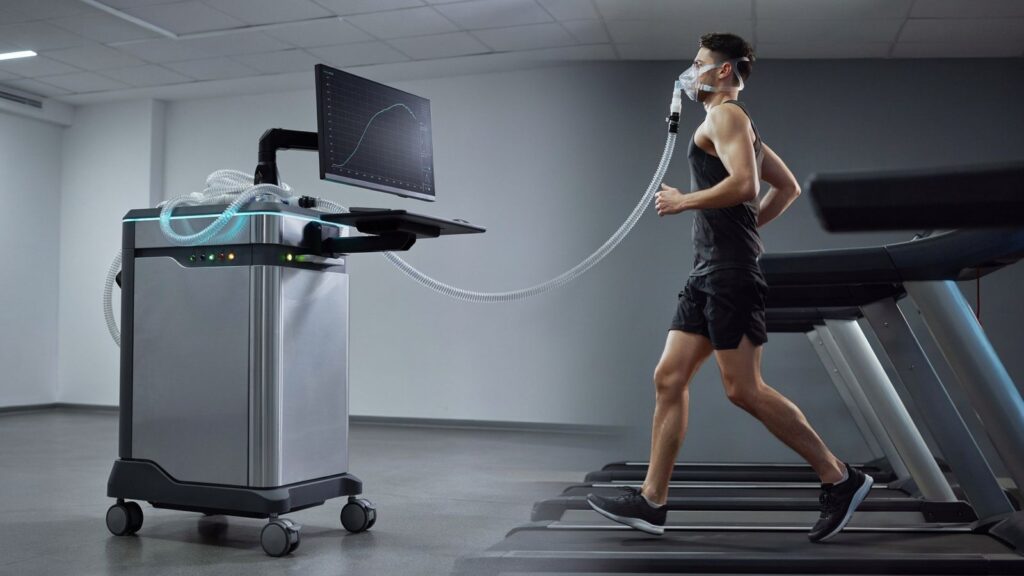
In late January 2026, Norwegian triathlete Kristian Blummenfelt — Tokyo Olympic gold medalist and multiple Ironman and 70.3 world champion — posted a series of training images to Instagram. Buried among them was a lab monitor showing a VO2max reading of 101.1 mL/kg/min. If accurate, it would be the first laboratory-recorded VO2max ever to break 100, surpassing a record that had stood for 14 years. The post set off one of the more genuinely interesting debates endurance sports science has seen in years — not just about Blummenfelt, but about what this number actually means and how much we should trust it.
What VO2max Actually Measures
VO2max is widely considered the gold-standard indicator of aerobic fitness — the maximum volume of oxygen your body can take in, transport, and use per minute, per kilogram of body weight, during maximal exertion. It reflects the combined capacity of your lungs, heart, blood, and muscles working together, and it’s strongly linked to both athletic performance and long-term health, with higher values consistently associated with lower all-cause mortality risk in research. For context on where typical values fall: an untrained man in his 20s might score 35 to 45, a score of 58.5 or above is considered “superior” for that age group, and elite endurance athletes typically sit in the 70 to 85 range. Numbers above 90 are rare even among the world’s best.
The Record Blummenfelt Broke
Before this test, the recognized highest laboratory VO2max belonged to Oskar Svendsen, a Norwegian cyclist who recorded 97.5 mL/kg/min in 2012 at just 18 years old — a result long considered a genetic outlier from a teenager at his physiological peak. For comparison, cycling legend Greg LeMond recorded 92.5 at his competitive best, and modern Tour de France dominator Tadej Pogačar has been estimated in the high 90s. Blummenfelt’s reported 101.1, at age 31, would not only break Svendsen’s mark but do so at an age when VO2max typically plateaus or begins declining rather than still climbing.
Why Scientists Are Skeptical
The reaction from the sports science community was swift, and not universally impressed. Jeroen Swart, head of performance at the UAE Emirates-XRG cycling team, was among the most pointed critics, writing on social media that testing centres should “teach the physiologists how to calibrate a metabolic cart,” and questioning why unusually high VO2 readings seem to recur from the same region.
The more detailed methodological critique came from Jem Arnold, an exercise physiology researcher at the University of British Columbia. VO2max is conventionally calculated as the peak average oxygen uptake sustained over a 30-second window, not a single instantaneous reading. Arnold argued the 101.1 figure shown on Blummenfelt’s screen looked more like the single highest breath recorded during the test rather than a proper 30-second average — and estimated that accounting for normal breath-to-breath variability, the true 30-second mean was likely closer to 92 to 97. Separately, another physiologist flagged the test’s respiratory exchange ratio of 0.93, a marker used to confirm an athlete has genuinely reached maximal effort, as lower than what’s typically expected for a fully maximal test. Neither Blummenfelt nor his longtime coach, Olav Alexander Bu, has publicly clarified the exact testing protocol or confirmed whether the equipment was freshly calibrated for this specific session.
Why the Debate Matters More Than the Number
Whether or not 101.1 turns out to be the “true” scientifically defensible figure, the episode is a useful reminder of something worth understanding for anyone who tracks VO2max on a smartwatch or in a lab: the number is only as trustworthy as the protocol behind it. Calibration, the averaging window used, and confirmation of genuinely maximal effort all meaningfully affect the result. A single screenshot, however impressive, doesn’t carry the same weight as a peer-reviewed, protocol-controlled test. This doesn’t mean Blummenfelt isn’t an extraordinary physiological outlier — his competitive results, including an unofficial sub-6:45 iron-distance triathlon, speak for themselves regardless of this specific number — but it’s a genuine illustration of why sports scientists insist on rigorous methodology before accepting a record.
What This Means for Everyday Athletes
- VO2max doesn’t determine race results alone: even at elite level, fuelling, pacing, heat tolerance, and efficiency decide outcomes as much as raw aerobic ceiling.
- Consistency in testing matters more than a single number: if you track VO2max via a wearable or periodic lab test, comparing your own trend over time is more meaningful than fixating on any single reading.
- It is trainable, gradually: sustained aerobic training, including regular high-intensity intervals, reliably improves VO2max over months, even if the ceiling for most people is well below elite territory.
- A high VO2max is linked to longevity, not just performance: research consistently associates higher aerobic fitness with better long-term health outcomes, which is a genuinely useful reason to train it regardless of your competitive ambitions.
Whatever the final verdict on Blummenfelt’s 101.1, the underlying science of VO2max remains solid and useful for anyone serious about endurance training. The controversy is really about testing rigor, not about whether aerobic capacity matters — and on that point, the sports science community, sceptics included, is in full agreement — a rare moment of consensus in an otherwise noisy debate.
Sources
- Kristian Blummenfelt — Wikipedia
- Kristian Blummenfelt Just Set a VO2 Max Record. Or Did He? — Outside/Velo
- Is Kristian Blummenfelt’s ‘Record’ VO2 Max All It Seems? — 220 Triathlon
- Kristian Blummenfelt Sets VO2 Max Record — Slowtwitch
The information in this article is for educational purposes only and does not substitute professional medical or sports science advice.
The Active Arabia weekly
One article built on one named study, every week, in your inbox. No noise.
We never share your email. Unsubscribe in one click.