Seawater minerals athletic recovery is a popular idea among swimmers, triathletes and beach-sport athletes on the Red Sea and Gulf coasts: finish a hard session, walk into the sea, and let the “mineral bath” repair your muscles. The recovery benefit is real. The explanation most people give for it is not. This guide separates what the evidence supports (cold-water immersion) from what it doesn’t (absorbing magnesium through your skin), and gives a protocol you can actually use.
What seawater contains, and what your skin lets in
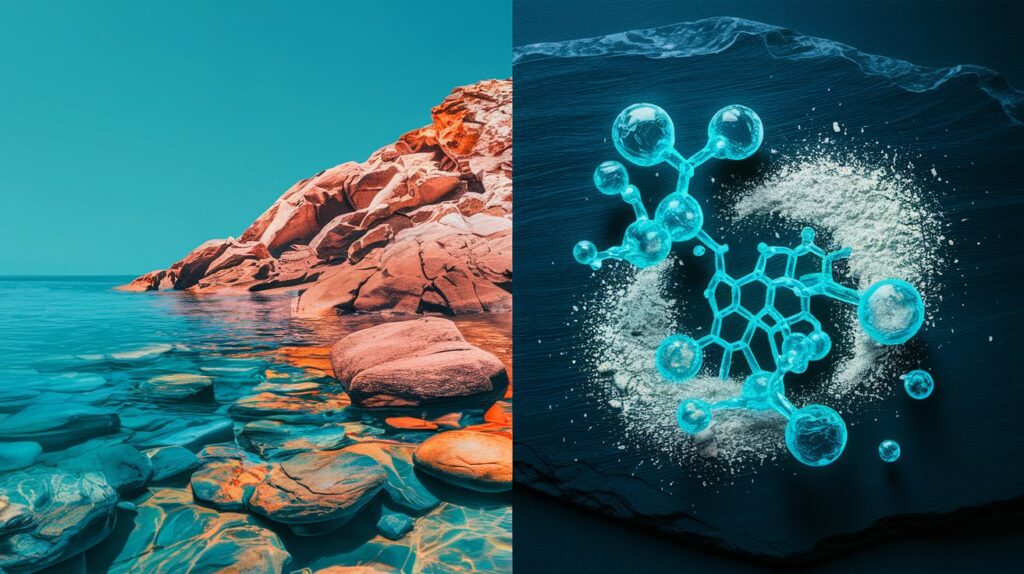
Seawater holds roughly 35 grams of dissolved salts per litre, mostly sodium chloride with smaller amounts of magnesium, calcium and potassium. Magnesium in particular gets credited with easing cramps and speeding repair, and it is true that magnesium is essential for muscle contraction and energy metabolism.
The problem is the delivery route. A 2017 review in the journal Nutrients examined every available study on transdermal magnesium and concluded that the claim is scientifically unsupported: the outer layer of skin (the stratum corneum) has no magnesium transporters, and the sweat glands and hair follicles that could let ions through make up under 1% of the skin’s surface. A 2026 laboratory study on human skin samples reached the same conclusion, finding that magnesium from simple salt solutions barely penetrates intact skin. If you are low in magnesium, the fix is food (leafy greens, nuts, seeds, legumes) or an oral supplement, not a swim.
Where seawater minerals athletic recovery actually comes from: the cold
Strip the mineral story away and what remains is cold-water immersion (CWI), one of the best-studied recovery methods in sports science. A 2025 network meta-analysis in Frontiers in Physiology pooled 55 randomised controlled trials and found that CWI reliably reduces delayed-onset muscle soreness (DOMS) and lowers creatine kinase, a blood marker of muscle damage, in the 24 to 48 hours after hard exercise. A separate 2023 meta-analysis in the same journal, covering 20 studies, reported similar reductions in soreness and perceived fatigue.
The mechanism is straightforward: cold constricts blood vessels, limits swelling and inflammation, and dampens pain signalling from damaged fibres. Seawater delivers that cold just as well as a plunge pool does. In winter and early spring, Gulf and Red Sea water sits in the range where these effects apply; in summer, when surface temperatures pass 30 °C, sea bathing is pleasant but is no longer cold-water immersion in any physiological sense.
Dose matters: temperature and time
The 2025 network meta-analysis compared immersion protocols and found that the best results for soreness came from water at roughly 10–15 °C for 10–15 minutes. Colder or longer was not consistently better, and very short dips did little. Timing also matters: most trials immersed athletes within 30 minutes of finishing exercise.
Practically, that means a five-minute paddle after a run does not count, and a 30-minute soak in cold water offers no advantage over 15. Sea bathing has one genuine edge over a bucket of ice: the whole body is immersed, and buoyancy lets you keep moving gently, which many athletes find easier to tolerate than sitting still in a tub.
The trade-off most guides skip
Cold-water immersion is not free. Because it blunts the inflammatory response, it also blunts some of the adaptations that inflammation triggers. A landmark study in The Journal of Physiology in 2015 showed that regular post-workout CWI reduced gains in muscle mass and strength over 12 weeks of resistance training compared with active recovery. Later reviews have confirmed the pattern for hypertrophy.
So the right question is not “does cold water help recovery?” but “what am I recovering for?” If you have another hard session or a race within a day or two, CWI is a sound choice. If you are in a strength-building block and the goal is adaptation rather than readiness, skip the plunge and let the soreness run its course.
A practical protocol for coastal athletes
- Use it for readiness, not for building. Reserve cold immersion for tournament weeks, back-to-back sessions, or after races. Avoid it after strength sessions in a hypertrophy phase.
- Check the water temperature. Aim for 10–15 °C. Below 20 °C you still get some effect; above that, treat the swim as active recovery rather than CWI.
- 10–15 minutes, within 30 minutes of finishing. Set a timer. Get out when it’s done.
- Keep the minerals in the diet. Sea bathing does not raise magnesium levels. Get it from food, and if you supplement, do it orally.
- Don’t swim alone or cold-stressed. Cold-water shock is a real drowning risk. Enter gradually, stay near shore, and get out and warm up if you start shivering hard.
- Away from the coast, a cold bath works the same. The mineral content of the water makes no measurable difference to recovery. Tap water at the right temperature gives the same benefit.
Bottom line
Seawater minerals athletic recovery works, but not for the reason usually given. The sea is a large, free cold-water immersion pool, and cold-water immersion has strong evidence for reducing soreness and muscle-damage markers in the 48 hours after hard training. The minerals are along for the ride: your skin does not absorb them in meaningful amounts. Use cold immersion when you need to be ready quickly, skip it when you are trying to build, and get your magnesium from your plate. For more research-backed training and recovery guides, see our research and studies section.
Sources
- Gröber U, et al. “Myth or Reality—Transdermal Magnesium?” Nutrients. 2017;9(8):813. doi:10.3390/nu9080813
- “Does magnesium permeate the skin? An ex vivo investigation of magnesium ion delivery through intact and barrier-disrupted skin.” European Journal of Pharmaceutics and Biopharmaceutics. 2026.
- Wang H, Wang L, Pan Y. “Impact of different doses of cold water immersion (duration and temperature variations) on recovery from acute exercise-induced muscle damage: a network meta-analysis.” Frontiers in Physiology. 2025;16:1525726. doi:10.3389/fphys.2025.1525726
- Machado AF, et al. “Effects of cold water immersion after exercise on fatigue recovery and exercise performance—meta analysis.” Frontiers in Physiology. 2023;14:1006512.
- Roberts LA, et al. “Post-exercise cold water immersion attenuates acute anabolic signalling and long-term adaptations in muscle to strength training.” The Journal of Physiology. 2015;593(18):4285-4301.
The Active Arabia weekly
One article built on one named study, every week, in your inbox. No noise.
We never share your email. Unsubscribe in one click.