Heart rate recovery — how quickly your pulse drops after you stop exercising — is emerging as one of the most powerful yet overlooked predictors of cardiovascular health. A landmark 2017 meta-analysis published in the Journal of the American Heart Association pooled data from nine prospective studies involving more than 41,000 participants to answer a critical question: does a slow recovery actually predict who develops heart disease or dies earlier, and by how much? The findings revealed that for every 10 beats-per-minute decrease in recovery speed, the risk of a cardiovascular event rose by 13%, and the risk of death from any cause increased by 9%—independent of traditional risk factors like obesity, diabetes, and cholesterol levels. For adults in Saudi Arabia, where cardiovascular disease rates continue to rise, understanding this marker offers a practical way to monitor heart function beyond standard checks. For more on how fitness protects your body over time, explore our strength and ageing guide.
What This Measurement Captures
Heart rate recovery (HRR) is the difference between your heart rate at peak exertion and your heart rate one or two minutes after you stop exercising. This simple measurement provides a noninvasive window into how well your autonomic nervous system—the automatic control system governing your heart, digestion, and stress response—is functioning. A healthy heart drops quickly once exercise stops, driven by rapid return of parasympathetic (“rest and digest”) activity. A heart that stays elevated reflects reduced parasympathetic tone and lingering sympathetic (“fight or flight”) dominance, a pattern researchers call autonomic dysfunction.
The Numbers Behind Heart Rate Recovery Research
The 2017 meta-analysis drew on five studies covering cardiovascular events—1,061 cases among 34,267 participants—and nine studies covering all-cause mortality, spanning 2,082 deaths among 41,600 participants. The pooled results were striking in their consistency: slower recovery predicted both cardiovascular events and mortality across diverse populations, regardless of age, sex, or baseline health status. Importantly, this association held independent of traditional risk factors, meaning slow recovery isn’t just a symptom of other known risks—it carries meaningful predictive information on its own. A separate 2018 study published in the same journal found that recovery measured just 10 seconds after stopping exercise also predicted mortality, suggesting that even earlier measurements may capture autonomic function with remarkable sensitivity.
Why Slow Recovery Matters Physiologically
The mechanism behind this predictive power centers on autonomic imbalance. When parasympathetic reactivation after exercise is sluggish, the heart spends more time under relatively higher sympathetic drive than it should. Over time, this pattern is linked to increased cardiac strain, greater susceptibility to dangerous heart rhythm disturbances, and a general state of heightened physiological stress on the cardiovascular system. Research has also connected poor recovery to elevated risk of developing type 2 diabetes, reinforcing that this single measurement reflects something genuinely systemic about how well the body regulates itself. In Saudi Arabia’s climate, where outdoor exercise often means coping with extreme heat, the cardiovascular system faces additional stress—making autonomic function monitoring especially relevant. If you are interested in how heart rate variability data prevents overtraining, the same autonomic principles apply.
How It Is Measured and What Healthy Looks Like
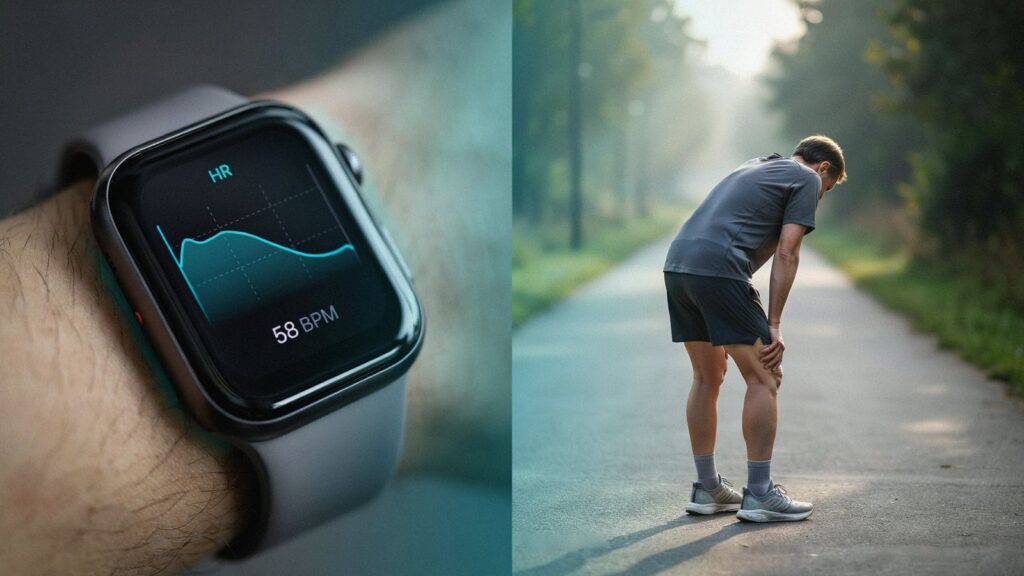
The traditional and most extensively validated method uses recovery at one or two minutes after peak exertion, typically captured during a supervised exercise stress test. The one-minute and two-minute windows remain the gold standard with the strongest evidence base. More recent research has examined recovery at just 10 seconds post-exercise as a potentially even more sensitive early marker. For practical purposes, a simpler version is achievable: note your heart rate at the peak of a hard exercise effort, stop, sit or stand still, and check your pulse again after exactly one minute. A modern fitness tracker or a simple pulse count both work. Many gym treadmills and cardio machines have built-in sensors that make tracking straightforward.
- Slow or concerning: A drop of less than roughly 12 beats per minute in the first minute after stopping is generally considered an attenuated, less favorable pattern in clinical research.
- Better recovery: A drop of 12 or more beats per minute in that first minute reflects healthier autonomic function, and larger drops generally reflect an even more favorable pattern.
- Trend matters more than one reading: A single measurement is a snapshot; tracking your own numbers over months as fitness changes gives a much more meaningful picture than comparing yourself to a generic cutoff.
- Consider the context: Hydration, heat exposure, sleep quality, and stress levels all influence speed—measure under similar conditions when tracking trends.
Can You Improve It?
Unlike some cardiovascular risk markers that are largely fixed, this is a trainable trait. Regular aerobic exercise—the same consistent, moderate-to-vigorous activity that improves overall cardiovascular fitness—reliably strengthens parasympathetic tone over time. Studies tracking recovery before and after structured training programs generally find measurable improvement within months. This makes it one of the more genuinely actionable numbers in cardiovascular health: unlike genetic risk factors, it responds directly to the kind of consistent physical activity already recommended for general health. Whether you’re walking, cycling, or performing traditional activities, giving your heart regular aerobic challenges provides a concrete, trackable signal of whether your training is actually improving how your heart functions.
Practical Steps
- Use a fitness tracker or smartwatch with continuous monitoring to capture peak exercise heart rate and one-minute recovery automatically.
- Measure at the same point in your workout routine—after your main cardio session—under similar conditions each time.
- Track your personal trend over 4–8 weeks rather than focusing on a single number; improvement indicates your cardiovascular fitness is progressing.
- If your one-minute recovery consistently stays below 12 beats per minute despite regular exercise, discuss this with your healthcare provider as part of a broader cardiovascular risk assessment.
- Combine tracking with other markers like resting heart rate and heart rate variability for a more complete picture of autonomic function.
Sources
- Heart Rate Recovery and Risk of Cardiovascular Events and All-Cause Mortality: A Meta-Analysis of Prospective Cohort Studies. Journal of the American Heart Association, 2017.
- Heart Rate Recovery at 10 Seconds After Exercise Testing and Risk of All-Cause Mortality. Journal of the American Heart Association, 2018.
The Active Arabia weekly
One article built on one named study, every week, in your inbox. No noise.
We never share your email. Unsubscribe in one click.