
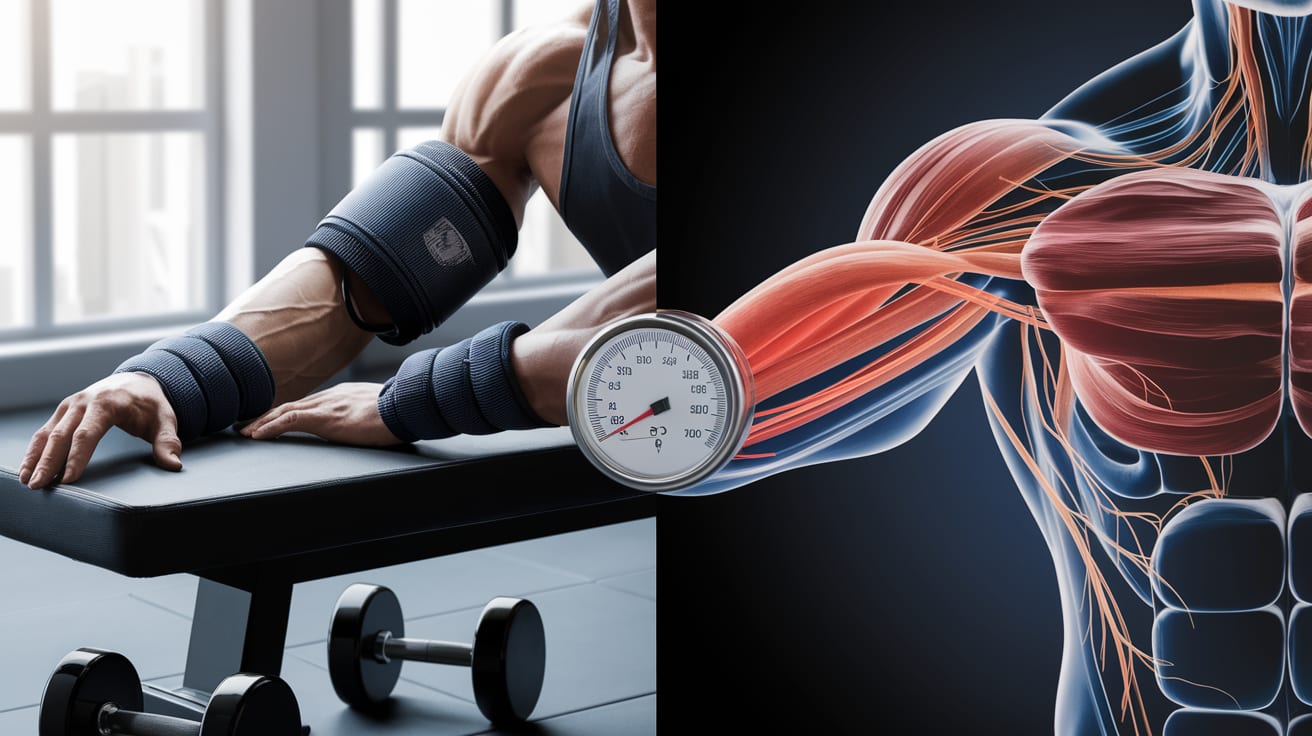
Blood flow restriction training builds significant muscle and strength using only light loads, according to a 2026 meta-analysis of 12 studies and 859 team-sport athletes published in Frontiers in Physiology. The analysis found that adding blood flow restriction training to regular resistance work significantly improved both muscle hypertrophy (SMD = 0.32, p = 0.02) and strength (SMD = 0.42, p < 0.001) compared to resistance training alone — meaning athletes and anyone recovering from injury can build meaningful muscle without heavy loads that stress joints and connective tissue.
What Is Blood Flow Restriction Training?
Blood flow restriction training, sometimes called occlusion training, involves wrapping a specialized cuff or band around the upper portion of a working limb — typically the arm or thigh — to partially restrict venous blood return while still allowing arterial inflow. The result is that blood pools in the working muscle, creating a metabolic environment usually associated with heavy lifting, even though the actual load being moved is light.
In practice, a BFR session looks deceptively easy. Instead of loading a squat at 80% of your one-rep maximum, you might use just 20 to 35% of your one-rep max while wearing the cuffs. The cuffs are inflated to between 60 and 80% of limb occlusion pressure — enough to slow venous return but not to cut off arterial supply entirely. Sets typically follow a protocol of 30-15-15-15 repetitions with short rest periods of 30 seconds between sets.
The concept originated in Japan in the 1960s through the work of Dr. Yoshiaki Sato, who noticed that his calf muscles were swollen after sitting in a kneeling position for extended periods. He spent decades developing the technique before it gained mainstream scientific attention in the 2000s, and it has since been studied in hundreds of clinical trials worldwide.
What the 2026 Meta-Analysis Found
The Huang et al. study, published in early 2026, is the most rigorous examination to date of blood flow restriction training specifically in team-sport athletes — football, basketball, handball, rugby, and volleyball players. The researchers conducted a systematic review and meta-analysis following PRISMA guidelines, searching PubMed, Web of Science, Cochrane Library, and SPORTDiscus from inception through September 2025.
Their analysis included 12 randomized controlled trials involving 859 team-sport athletes. The results were clear: compared to resistance training alone, adding BFR produced a statistically significant improvement in muscle hypertrophy with a standardized mean difference of 0.32 (95% CI: 0.05 to 0.58, p = 0.02) and a low heterogeneity of I² = 4%, meaning the results were consistent across studies. For muscle strength, the effect was even more pronounced, with an SMD of 0.42 (95% CI: 0.18 to 0.66, p < 0.001) and I² = 10%.
However, the researchers found no statistically significant improvement in explosive power measures such as jumping height or sprint speed. This is an important caveat: BFR appears to build muscle size and maximal strength effectively, but it does not directly transfer to the kind of explosive, high-velocity movements that team-sport athletes rely on during competition.
The Physiological Mechanism Behind Blood Flow Restriction Training
The muscle-building effects of blood flow restriction training are driven by metabolic stress rather than mechanical tension. When venous return is restricted, metabolites — particularly lactate, hydrogen ions, inorganic phosphate, and reactive oxygen species — accumulate rapidly in the working muscle. This metabolic environment triggers several adaptive responses.
First, the accumulation of hydrogen ions lowers intracellular pH, which appears to accelerate the recruitment of fast-twitch (type II) muscle fibers. These are the same fibers typically recruited only during heavy lifting or maximal efforts, yet BFR allows them to be activated with loads as low as 20% of one-rep maximum. Second, the metabolic stress stimulates the release of growth hormone — studies have shown increases of up to 290 times baseline levels after BFR exercise. Third, cell swelling from blood pooling activates the mTOR pathway, a key signaling cascade for muscle protein synthesis.
A second 2026 meta-analysis by Yang et al., published in the Journal of Human Kinetics, examined 40 studies involving 839 athletes and active participants. They found that BFR training moderately improved pulmonary function (effect size 0.81 to 0.88, p < 0.01) and muscle hypertrophy (effect size 0.73 to 0.74, p < 0.01), though it did not significantly improve cardiac function or change anthropometric measures like body fat percentage.
BFR Training for Rehabilitation
One of the most compelling applications of blood flow restriction training is in musculoskeletal rehabilitation. A 2026 scoping review by Atmaca et al., published in BMC Sports Science, Medicine and Rehabilitation, analyzed 21 randomized controlled trials and found that low-load BFR training — using 20 to 35% of one-rep maximum with 60 to 80% occlusion over 4 to 12 weeks — produced significant improvements across 11 different musculoskeletal conditions.
This matters enormously for athletes recovering from ACL reconstruction, tendon injuries, or joint surgery. These patients often cannot tolerate the heavy loads needed for traditional strength training, yet they face rapid muscle atrophy if they do not load the tissue. BFR offers a solution: the ability to stimulate meaningful strength and hypertrophy gains with loads that are safe for compromised joints and healing tissues.
The Atmaca review noted that evidence for the participation domain — return to sport and return to work — was limited, with only 7 of 21 studies measuring quality of life outcomes and none measuring return-to-sport using clearance-based metrics. This is an important gap that future research needs to address.
Practical Applications and Safety Considerations
For athletes and gym-goers interested in incorporating BFR training, several practical considerations matter. Cuff width affects occlusion pressure — wider cuffs (10 to 15 cm for legs, 5 to 9 cm for arms) require lower pressures than narrow cuffs. The standard protocol uses four sets of 30-15-15-15 repetitions with 30-second rest periods, performed two to three times per week.
The Yang et al. meta-analysis found that BFR was most beneficial when applied to young trained participants with intervention durations of less than six weeks and frequencies of fewer than three sessions per week. This suggests that BFR may work best as a short-term training tool rather than a year-round strategy.
Safety is a common concern, but systematic reviews have found no increased risk of deep vein thrombosis, cardiovascular events, or significant blood pressure changes in healthy populations using properly applied BFR protocols. However, individuals with cardiovascular disease, hypertension, pregnancy, or a history of blood clots should avoid BFR training unless cleared by a physician.
Practical Takeaways
- BFR builds muscle with light loads. A 2026 meta-analysis of 859 athletes confirmed that adding BFR to resistance training significantly improved muscle hypertrophy and strength compared to training alone.
- Use 20-35% of your one-rep max. The research consistently uses loads in this range, which is light enough to protect joints while still stimulating growth through metabolic stress.
- Follow the 30-15-15-15 protocol. Four sets with 30-second rest periods between sets is the most studied and validated approach.
- BFR does not improve explosive power. If your sport requires jumping or sprinting, BFR alone will not enhance those qualities — use it as a supplement, not a replacement.
- Short-term use may be optimal. Evidence suggests BFR is most effective in blocks of four to six weeks, two to three sessions per week.
- Consult a professional for rehabilitation. BFR shows strong promise for post-surgical and injury recovery, but should be guided by a qualified physiotherapist.
Related on Active Arabia: science-backed exercises that actually work and a beginner’s guide to simple resistance training.
Sources
- Huang Q, Xiao L, Zheng S, Meng S, Yue S. “Muscle hypertrophy and strength improvements following blood flow restriction combined with resistance training in team-athletes: a systematic review and meta-analysis.” Frontiers in Physiology, 2026.
- Yang K, Chee CS, bin Abdul Kahar J, Kamalden TFT, Li R, Qian S. “Effects of Blood Flow Restriction Training on Cardiopulmonary Function and Body Composition: A Systematic Review with Meta-Analysis.” Journal of Human Kinetics, 2026.
- Atmaca SN, Çolak BB, Saatçı EZ, Ejraei N, Yıldız A. “Blood flow restriction training in musculoskeletal rehabilitation: a comprehensive scoping review of randomised controlled trials.” BMC Sports Science, Medicine and Rehabilitation, 2026.
This article is for educational purposes only and does not constitute medical advice. Consult a qualified healthcare professional before beginning any new training program, especially if you have cardiovascular conditions or a history of blood clots.
The Active Arabia weekly
One article built on one named study, every week, in your inbox. No noise.
We never share your email. Unsubscribe in one click.