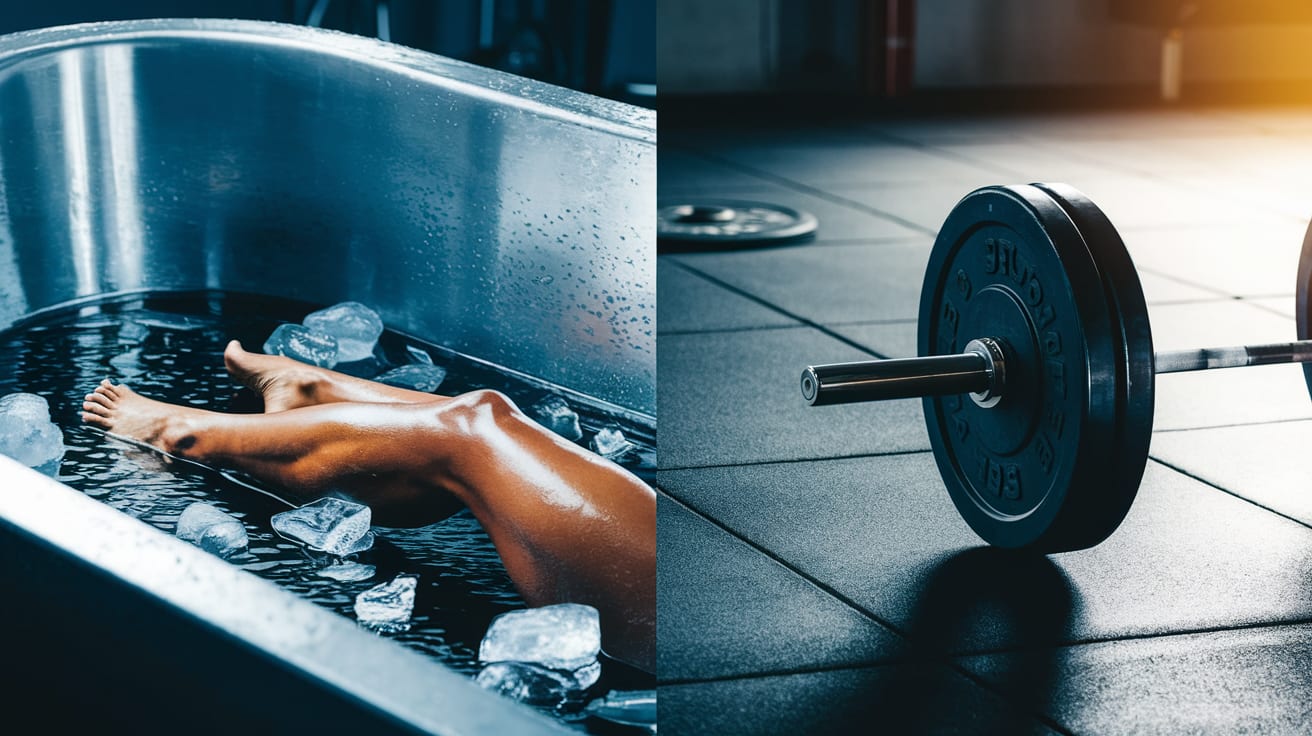
Cold water immersion has become a staple of post-workout recovery routines worldwide, from elite athletes to weekend gym-goers. But a 2026 narrative review published in Experimental Physiology has revealed a striking paradox: the same cold water immersion recovery protocols that accelerate recovery and reduce muscle soreness may simultaneously suppress the very muscle-building adaptations that resistance training is designed to produce. This finding challenges the assumption that more recovery is always better, and it has significant implications for how athletes in the Gulf region and beyond structure their training.
What Is the Cold Water Immersion Recovery Paradox?
The cold water immersion recovery paradox describes a fundamental contradiction in sports science: acute cold water immersion (CWI) at 10–15°C for 10–15 minutes consistently accelerates parasympathetic nervous system reactivation and reduces perceived muscle soreness within 24 to 72 hours after exercise. Yet when the same protocols are applied repeatedly across a resistance-training mesocycle, they suppress the molecular and cellular machinery of skeletal muscle hypertrophy. In other words, the very act of recovering faster may be robbing you of long-term gains.
This paradox was comprehensively documented by Tornero-Aguilera and colleagues in their 2026 review, which synthesized evidence from network meta-analyses, molecular studies, and longitudinal training trials. The authors concluded that CWI is neither uniformly beneficial nor uniformly harmful — its effects are predictable and depend entirely on the training goal.
The Acute Benefits: Faster Recovery and Less Soreness
The short-term benefits of cold water immersion are well-established. A network meta-analysis cited in the 2026 review found that CWI ranked highest among recovery modalities for reducing delayed-onset muscle soreness, with a SUCRA (Surface Under the Cumulative Ranking) score of 88%. Athletes who immersed themselves in cold water (10–15°C) for 10–15 minutes after intense exercise reported significantly lower soreness at 24, 48, and 72 hours compared to passive recovery or no intervention.
Cold water immersion also accelerates parasympathetic reactivation — the shift from the “fight or flight” sympathetic state to the “rest and digest” mode that promotes recovery. Heart rate variability studies confirm that CWI restores autonomic balance faster than passive rest, which is why many elite sports teams use ice baths between competition sessions in tournaments.
For athletes who need to perform again within 24 to 48 hours — such as footballers playing consecutive matches or competitors in multi-day events — these acute benefits are genuinely valuable. The cold water immersion recovery paradox does not negate these short-term advantages; it simply reveals that they come at a cost when applied chronically.
The Hidden Cost: Blunted Muscle Growth Signals
Here is where the cold water immersion recovery paradox becomes critical for anyone whose primary goal is building muscle or increasing strength. The 2026 review documented that repeated CWI after resistance training attenuates the mechanistic target of rapamycin complex 1 (mTORC1) signaling pathway — the central molecular regulator of muscle protein synthesis. It also suppresses ribosomal biogenesis (the cell’s ability to build more protein-making machinery) and reduces satellite-cell-mediated myonuclear addition (the process by which muscle fibers recruit new nuclei to support growth).
The practical consequence is measurable: longitudinal training studies show that athletes who regularly use CWI after resistance training experience reduced type II muscle fibre cross-sectional area and modest impairments in strength gain, with a pooled effect size of −0.23. While this effect size may seem small, over a 12-week training block it could translate to meaningful differences in muscle mass and strength outcomes.
This is particularly relevant for bodybuilders, strength athletes, and anyone in a hypertrophy-focused training phase. If your primary goal is to build muscle, using cold water immersion after every resistance session may be counterproductive.
Why Endurance Athletes May Be Less Affected
Importantly, the cold water immersion recovery paradox does not apply equally to all types of training. The 2026 review found that endurance-related microvascular and mitochondrial adaptations appear less affected by CWI and may even be selectively enhanced. A separate 2026 network meta-analysis by Jin and colleagues in Frontiers in Sports and Active Living found limited evidence that any physical recovery modality outperforms passive recovery in competitive endurance athletes — but cold water immersion did not significantly impair their performance adaptations either.
This suggests that endurance athletes — runners, cyclists, swimmers — may be able to use CWI for acute recovery without sacrificing long-term performance gains. The molecular signals that drive endurance adaptations (mitochondrial biogenesis, capillary density) appear more resilient to the anti-inflammatory effects of cold exposure than the signals that drive hypertrophy.
A Decision Framework: When to Use Cold Water Immersion
The authors of the 2026 review proposed a protocol-by-goal decision framework that links CWI parameters — water temperature, duration, body coverage, and temporal placement — to expected adaptive outcomes. The key principle is simple: use CWI when fast recovery between sessions matters most, and withhold it after resistance training when muscle growth is the primary goal of the training block.
For hypertrophy-focused training: avoid CWI after resistance sessions. Use active recovery, light movement, or passive rest instead.
For strength-focused training: use CWI sparingly. Reserve it for competition phases or when you must recover quickly between high-intensity sessions.
For endurance training: CWI is generally safe to use for acute recovery, as it does not appear to impair the key adaptations that drive endurance performance.
For concurrent training (mixed strength and endurance): prioritize the adaptation you care about most. If strength is the priority, skip the ice bath after lifting days.
Practical Implications for Athletes in the Gulf Region
The cold water immersion recovery paradox has particular relevance for athletes training in the Gulf, where extreme heat makes recovery modalities especially appealing. Many gyms and sports facilities in Saudi Arabia, the UAE, and Qatar now offer ice baths and cold plunges as standard recovery tools. Athletes should be aware that while these modalities feel beneficial and do reduce soreness, they may be undermining their strength and hypertrophy goals if used indiscriminately.
The key takeaway is not to avoid cold water immersion entirely, but to use it strategically. Align your recovery protocol with your training goal, and recognize that faster recovery is not always better recovery.
Practical Takeaways
- Cold water immersion at 10–15°C for 10–15 minutes reduces muscle soreness by 24–72 hours and accelerates parasympathetic recovery.
- Repeated CWI after resistance training suppresses mTORC1 signaling, ribosomal biogenesis, and satellite-cell activity, reducing muscle growth.
- Longitudinal studies show a modest but measurable impairment in strength gain (effect size −0.23) with regular post-exercise CWI.
- Endurance-related adaptations (mitochondrial biogenesis, capillary density) appear less affected by CWI.
- Use CWI strategically: reserve it for competition phases, multi-day events, or endurance training — not after hypertrophy-focused resistance sessions.
- Align your recovery protocol with your training goal: faster recovery is not always better recovery.
Related on Active Arabia: what seawater immersion actually does for recovery and athletic bradycardia in endurance athletes.
Sources
- Tornero-Aguilera JF, Lozano-Meca J, López-Moreno M, et al. “The cold-water immersion recovery–adaptation paradox: Reconciling acute parasympathetic and analgesic benefits with chronic hypertrophy attenuation.” Experimental Physiology, 2026. doi.org/10.1113/EP093519
- Jin Y, Pan D, Li M, Zhu D, Wen J. “Recovery modalities in competitive and elite endurance athletes: a systematic review and network meta-analysis finding limited evidence of benefit over passive recovery.” Frontiers in Sports and Active Living, 2026.
Disclaimer
This article is for educational purposes only and does not constitute medical or professional advice. Always consult a qualified healthcare provider or sports scientist before making changes to your training or recovery protocol.
The Active Arabia weekly
One article built on one named study, every week, in your inbox. No noise.
We never share your email. Unsubscribe in one click.