
Two people can share the exact same body mass index and carry very different amounts of risk. That’s the central finding behind a landmark 2020 study published in The BMJ, which pooled data from 72 prospective cohort studies and more than 2.5 million participants to answer a question BMI alone can’t: does *where* your fat sits on your body matter as much as how much of it you carry? The answer, delivered with unusual statistical clarity, is yes — and the details reveal something genuinely useful about how to think about body fat and long-term health.
The Scale of the Study
Researchers led by Ahmad Jayedi screened nearly 99,000 studies, reviewed close to 2,000 in full, and ultimately combined data from 72 prospective cohort studies tracking a combined 2,528,297 people. This is one of the largest analyses ever conducted on body fat distribution and mortality, examining eight separate measures of central, or abdominal, fatness: waist circumference, hip circumference, thigh circumference, waist-to-hip ratio, waist-to-height ratio, waist-to-thigh ratio, body adiposity index, and a measure called A Body Shape Index. Crucially, the analysis adjusted for BMI throughout — meaning the findings reflect the effect of fat distribution independent of overall body size, not simply a proxy for being heavier overall.
What the Numbers Actually Show
The results were consistent and precise. Every 10-centimetre increase in waist circumference was associated with an 11% higher risk of death from any cause. Waist-to-hip ratio showed an even stronger association: every 0.1-unit increase corresponded to a 20% higher mortality risk, and waist-to-height ratio showed a 24% higher risk per 0.1-unit increase. These associations held even after accounting for BMI, confirming that where fat accumulates around the abdomen carries meaningful, independent risk information beyond simply how much someone weighs.
The Genuinely Surprising Finding
Here’s the part of the study that reframes the whole picture: hip circumference and thigh circumference moved in the opposite direction. Every 10-centimetre increase in hip circumference was associated with a 10% *lower* risk of death, and every 5-centimetre increase in thigh circumference was linked to an 18% *lower* risk. In other words, fat and muscle carried on the hips and thighs appear to be protective, not harmful — a striking contrast to the waist-based measures. This helps explain why body shape, not just body size, has become such a focus in more recent research: a “pear” shaped body, with fat distributed more toward the hips and thighs, is consistently associated with better outcomes than an “apple” shape, where fat concentrates around the abdomen, even at an identical overall weight.
Why Abdominal Fat Specifically Carries More Risk
The likely explanation lies in the type of fat found in each location. Fat around the abdomen tends to include a higher proportion of visceral fat — fat stored around internal organs rather than just beneath the skin — which is metabolically active in ways that contribute to insulin resistance, inflammation, and cardiovascular strain. Fat carried on the hips and thighs, by contrast, is predominantly subcutaneous fat, which appears to be comparatively metabolically benign and, according to some research, may even help regulate blood sugar and lipid levels favourably. This distinction is part of why two people at the same BMI can have meaningfully different health risk profiles depending on where their body stores fat.
Measuring Your Own Waist Circumference
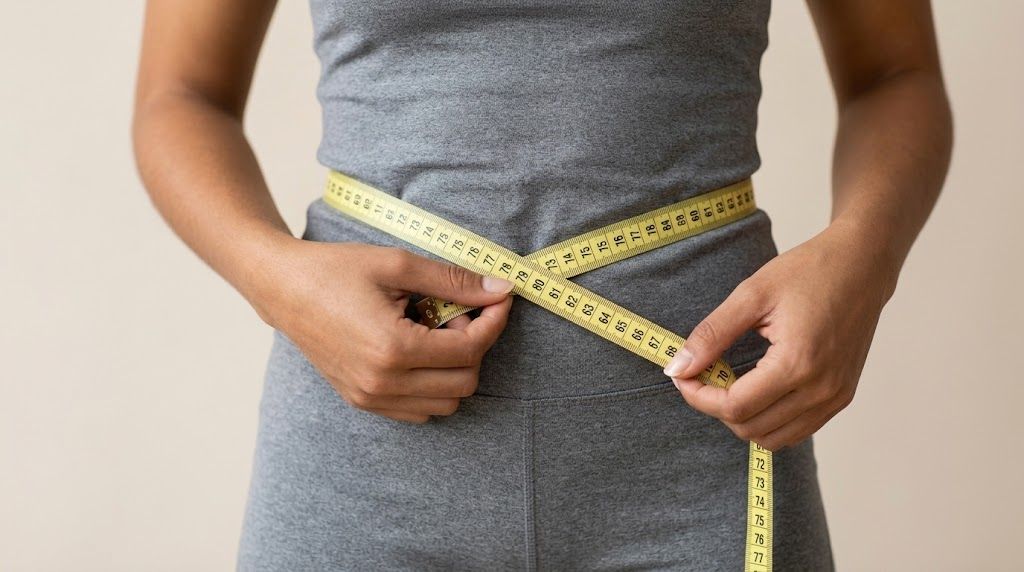
Unlike some health metrics, this one requires no special equipment — just a flexible tape measure. The standard method: stand relaxed, locate the top of your hip bone and the bottom of your rib cage, and measure around your waist at the midpoint between the two, keeping the tape snug but not compressing the skin, after a normal exhale. Commonly cited general risk thresholds are a waist circumference above roughly 94cm for men and 80cm for women, with substantially elevated risk above about 102cm and 88cm respectively — though these are population-level reference points, not individual diagnoses, and should be interpreted alongside overall health context rather than in isolation.
What This Means in Practice
- BMI alone doesn’t tell the full story: two people with identical BMI can carry meaningfully different mortality risk depending on where their fat is distributed — waist measurement adds real, independent information.
- Waist circumference is a simple, useful metric to track: unlike more complex body composition tools, it requires only a tape measure and takes seconds, making it easy to monitor over time.
- Reducing abdominal fat specifically matters: aerobic exercise and resistance training both show consistent evidence of preferentially reducing visceral abdominal fat, even when total weight change is modest.
- Don’t panic over hip or thigh size: this research suggests fuller hips and thighs are not a health liability — in fact, quite the opposite — so the focus for risk reduction should be specifically on the waist, not overall body size.
- Combine with other health markers: waist circumference is one useful data point among several — pairing it with measures like grip strength or heart rate recovery gives a fuller picture than any single number alone.
The core takeaway from this research is a genuine refinement of how to think about body fat and health: it isn’t simply about total weight or even total fat, but about where that fat is carried. A tape measure around the waist, tracked consistently over time, offers a simple, well-evidenced window into a risk factor that BMI alone will always miss.
Sources
The information in this article is for educational purposes only and does not substitute professional medical advice.
The Active Arabia weekly
One article built on one named study, every week, in your inbox. No noise.
We never share your email. Unsubscribe in one click.