Sucralose Gestational Diabetes: What a New Study Reveals About Artificial Sweeteners and Pregnancy
Did you know that consuming sucralose during pregnancy may raise the risk of gestational diabetes? A recent Chinese study published in the Journal of Diabetes Research in 2026 uncovered a striking mechanism: artificial sweeteners don’t just affect calories — they may reshape gut bacteria in ways that elevate blood sugar levels. This article reviews the findings and what they mean for pregnant women in the Arab world.
What is gestational diabetes and why does it matter?
Gestational diabetes is a form of high blood sugar that develops during pregnancy, affecting approximately 10-15% of pregnant women globally. In Saudi Arabia and Gulf countries, the rate is even higher due to factors like obesity and sedentary lifestyles. If not properly managed, it can lead to complications for both mother and baby, including preterm birth, excessive birth weight, and increased risk of type 2 diabetes later in life.
The new study from Zhejiang University in China provides evidence that artificial sweeteners — often marketed as a “healthy alternative” to sugar — may carry hidden risks for pregnant women.
Study details: What did researchers do?
Research team leader Dr. Song Jia from the Department of Obstetrics at Zhejiang University designed an experiment using pregnant mice, exposed to sucralose in their drinking water from the earliest stage of pregnancy (embryonic day 0.5) through the full gestation period. The researchers tested two exposure levels — a low dose of 24 mg/L and a high dose of 72 mg/L — against a control group that received no sweetener, allowing them to see whether the effects scaled with how much sucralose the mice consumed.
The results were dose-dependent. In glucose tolerance testing, the high-dose group showed significantly elevated peak blood glucose at both 30 and 60 minutes after a glucose challenge, along with hyperinsulinemia and a significantly elevated HOMA-IR score — the standard marker of insulin resistance (p < 0.05). The low-dose group showed milder changes, with no statistically significant shift in insulin markers, suggesting a real threshold effect rather than an all-or-nothing risk. Overall, mice exposed to sucralose showed:
- Significantly increased rates of gestational diabetes, most pronounced at the higher dose
- Elevated blood glucose levels on glucose tolerance testing
- Reduced insulin sensitivity, reflected in higher HOMA-IR scores
- Marked disruption in gut bacteria balance
Most importantly, the researchers used fecal transplantation to establish causality: when gut bacteria from sucralose-exposed pregnant mice were transferred to healthy pregnant mice, those recipients also developed gestational diabetes symptoms — strong evidence that the gut microbiome itself, not just the sweetener directly, was driving the metabolic disruption.
The mechanism: How does sucralose affect gut bacteria?
Analysis of 16S rRNA sequencing revealed specific, dose-dependent changes in microbiome composition:
- Decrease in beneficial bacteria such as Prevotellaceae UCG-001 and Lachnospiraceae UCG-001, with the reduction becoming more pronounced as the sucralose dose increased
- Increase in pro-inflammatory bacteria such as Parasutterella — seen at both the low and high dose, unlike the beneficial-bacteria loss, which only became significant at the higher dose
- A shift in the broader balance of gut bacteria at the high dose, with an increase in Firmicutes and a decrease in Bacteroidetes — a ratio shift that other research has linked to metabolic disease more generally
- Changes in fecal metabolites, including 5-aminopentanoic acid
These changes were strongly correlated with elevated blood sugar levels and impaired insulin response. In other words, sucralose didn’t just change which bacteria were present — it changed how those bacteria interact with glucose metabolism, and the size of that effect tracked how much sucralose the mice were exposed to.
Effects across generations: What happened to offspring?
One of the most intriguing — and dose-specific — findings was sucralose’s effect on the mice’s offspring. At the low dose, maternal sucralose exposure was associated with increased offspring birth weight. At the high dose, the pattern reversed: offspring were born lighter than the control group. The effect also appeared to be sex-specific — by four weeks after weaning, female offspring from the high-dose group had significantly lower body weight than female control offspring, while no equivalent difference was observed in male offspring.
This suggests that exposure to artificial sweeteners during pregnancy may leave a metabolic imprint on offspring that differs by dose and by sex — an area the study’s authors flag as needing further, longer-term research rather than a settled conclusion.
In the Gulf context, where gestational diabetes and obesity rates are high, these findings warrant caution. Epidemiological studies suggest that approximately 25-30% of pregnant women in Gulf countries experience gestational diabetes, and any dietary factor that may increase this risk deserves attention.
What does this mean for pregnant women in the Arab world?
Before you panic, it’s important to understand what these results mean:
- The study was on mice: Results from animal experiments don’t always translate directly to humans. However, the biological mechanisms related to gut bacteria and metabolism are quite similar across mammals.
- Dose matters: The clearest insulin-resistance and gut-bacteria effects only reached statistical significance at the higher dose (72 mg/L) tested in the study; the lower dose (24 mg/L) showed milder, less consistent changes. Occasional, small consumption may not carry the same risk as regular high intake.
- Overall dietary context: Sucralose’s impact cannot be isolated from the overall diet. A pregnant woman who consumes sucralose in a diet drink but eats a diet rich in vegetables and fiber may have a different situation than another pregnant woman.
But the overall message is clear: artificial sweeteners are not “neutral” as once believed. They are biologically active substances that affect gut bacteria and metabolism.
What the study doesn’t yet tell us
The authors themselves are careful about the limits of this work, and it’s worth being just as careful in reading it. This was a mouse study with no human clinical data yet — the researchers describe the associations they found between gut metabolites and metabolic outcomes as established, but note that direct causality beyond the fecal-transplant experiment isn’t fully confirmed. Fecal samples were only collected in the third trimester, so how these bacterial changes develop earlier in pregnancy is still unknown, and a small number of cage replicates limited how far the team could statistically analyze differences in how much water (and therefore sucralose) each group actually drank. The authors frame their findings as grounds for more evidence-based dietary guidance in pregnancy, and for treating artificial sweeteners as a potential environmental contributor to gestational diabetes worth studying further — not as proof that moderate sucralose use is dangerous for any individual pregnant woman.
Safer sweetening alternatives during pregnancy
If you’re pregnant and aiming to reduce sugar, here are safer alternatives:
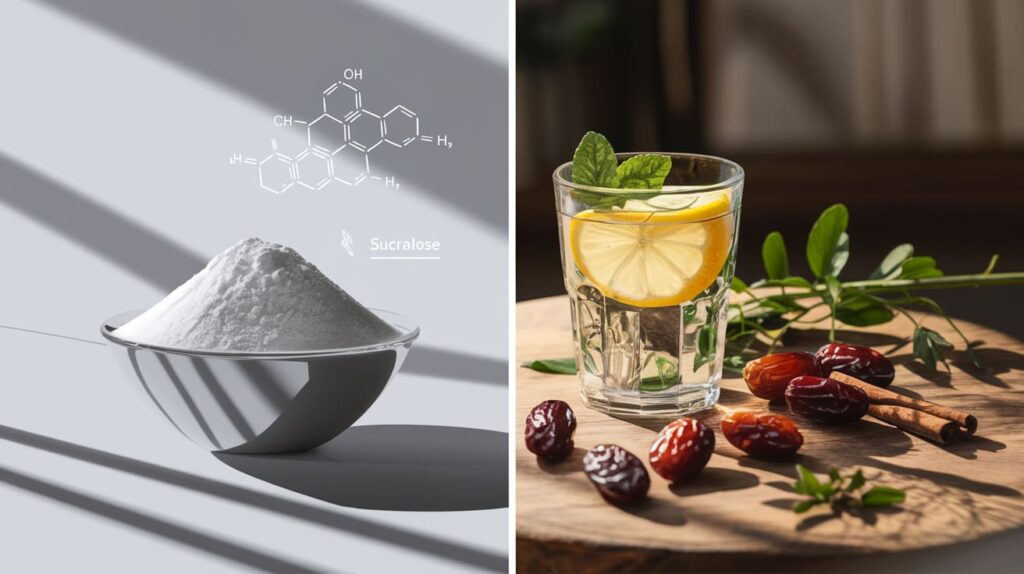
- Moderate dates: Rich in fiber and potassium, but count the quantity due to natural sugar
- Fresh fruit: Apples, pears, berries — all excellent choices in reasonable amounts
- Cinnamon: Adds natural sweetness and may help regulate blood sugar
- Infused water: Add lemon or mint slices to water instead of sweetened beverages
- Consult a nutritionist: Every pregnancy is unique, and experts can provide personalized plans
Key takeaways
- A 2026 study from Zhejiang University found that sucralose exposure during pregnancy increased gestational diabetes risk in mice through gut microbiota disruption, using drinking-water doses of 24 mg/L (low) and 72 mg/L (high)
- Effects were dose-dependent: the high dose produced significant insulin resistance (elevated HOMA-IR) and clearer gut-bacteria disruption than the low dose
- The mechanism involved reduced beneficial bacteria (Prevotellaceae, Lachnospiraceae) and increased pro-inflammatory bacteria (Parasutterella)
- Fecal transplantation confirmed causality — transferring gut bacteria from sucralose-exposed mice to healthy mice induced gestational diabetes symptoms
- Offspring effects were both dose- and sex-specific: low-dose exposure was linked to higher birth weight, high-dose exposure to lower birth weight and reduced body weight in female offspring specifically
- The study’s own authors caution this is mouse-only evidence without human clinical confirmation yet
- Pregnant women should consult healthcare providers before consuming products with artificial sweeteners
- Whole-food alternatives like moderate dates, fresh fruit, and cinnamon may be safer options
Disclaimer: This article is for educational purposes only and does not replace professional medical advice. Always consult your healthcare provider before making dietary changes during pregnancy.
Sources
- Song J, He J, Liang Z. Sucralose Exposure During Pregnancy Elevates Gestational Diabetes Risk via Gut Microbiota-Metabolic Axis in Mice. J Diabetes Res. 2026;2026(1):e8638903. doi:10.1155/jdr/8638903
- Zhejiang University. Department of Obstetrics, Women’s Hospital, School of Medicine.
- PMC13170706 – Full text available
The Active Arabia weekly
One article built on one named study, every week, in your inbox. No noise.
We never share your email. Unsubscribe in one click.