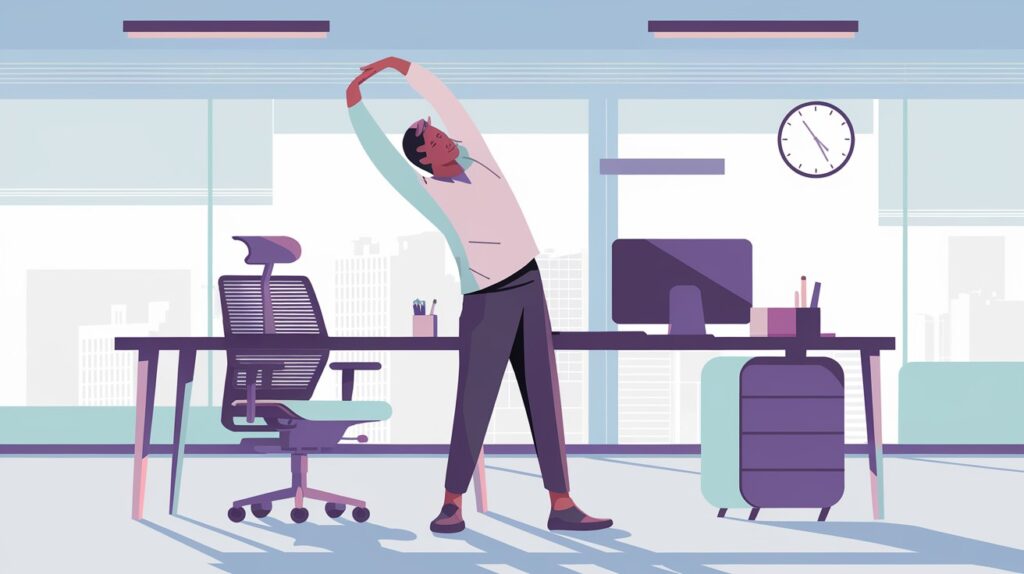
Daily movement breaks—brief bouts of standing, walking, or stretching every 30 to 60 minutes—can reduce sedentary time by nearly 25 minutes per workday and significantly improve both physical and mental outcomes, according to a 2025 one-year study of Japanese office workers published in the Scandinavian Journal of Work, Environment & Health. For professionals in Saudi Arabia, where desk-based work and long commuting hours contribute to some of the highest sedentary times in the region, these findings offer a practical, evidence-based strategy to protect metabolic health, sustain cognitive focus, and reduce the risk of chronic disease without requiring a gym membership or major schedule changes.
What the research shows about daily movement breaks
The Kitano et al. (2025) quasi-experimental study followed 172 office workers in an intervention group and 323 in a control group over 12 months. The intervention introduced approximately 10 minutes of active breaks per working hour—standing, walking, or light stretching—supported by social encouragement and informational resources. Accelerometer data showed that sedentary behavior during work hours decreased by 24.4 minutes (95% CI: 17.3–31.6), light-intensity physical activity increased by 12.6 minutes, and moderate-to-vigorous activity rose by 10.1 minutes. Adherence remained high: 66.9% of participants “almost always” took their breaks after 12 months. A 2026 three-level meta-analysis by Zhuang et al., published in the International Journal of Behavioral Nutrition and Physical Activity, confirmed that interrupting prolonged sitting with brief standing or activity breaks produces acute improvements in cognitive performance, particularly working memory and attention.
Why daily movement breaks matter for metabolic health
Continuous sitting suppresses lipoprotein lipase activity, reduces glucose uptake in skeletal muscle, and impairs endothelial function within as little as two hours. These metabolic disruptions accumulate across the workday and are not fully reversed by a single evening workout. The Kitano study demonstrated that distributed movement—short breaks spread across eight hours—significantly reduced total sedentary time and increased step count by 1,180 steps per workday. A second 2026 meta-analysis by Huang et al., also in the International Journal of Behavioral Nutrition and Physical Activity, found that breaking up prolonged sitting with physical activity improved executive function, including task-switching and inhibitory control, with effects observable after single bouts as short as three to five minutes. For Saudi workers, where our guide to daily movement strategies and heat limits outdoor activity for much of the year, indoor movement breaks offer a feasible, climate-independent way to maintain metabolic activation throughout the day.
How to implement daily movement breaks in a Saudi workday
The evidence suggests that frequency matters more than intensity. The Kitano intervention aimed for roughly 10 minutes per hour, but the Zhuang meta-analysis showed cognitive benefits from breaks as brief as two to three minutes. Practical approaches include setting a phone or computer alarm every 45 to 60 minutes, standing during phone calls, walking to a colleague’s desk instead of emailing, or performing two minutes of stretching at your workstation. The Japanese study found that departments which developed their own break schedules—tailoring timing and activities to workflow—achieved higher adherence than those with rigid, top-down protocols. In Saudi offices, aligning movement breaks with prayer times or tea breaks can embed the habit into existing routines. The key is consistency: the Kitano participants who took breaks “almost always” saw the largest reductions in sedentary time.
Addressing common concerns about productivity
Many workers and managers worry that frequent movement breaks will reduce output. The Kitano study directly measured subjective job performance and found no significant difference between the intervention and control groups at 12 months. The Zhuang meta-analysis went further, showing that brief activity breaks actually improved working memory and attention—cognitive functions essential for complex tasks. The Huang meta-analysis confirmed improvements in executive function, suggesting that movement breaks may enhance, rather than disrupt, mental performance. For Saudi professionals working long hours, especially during Ramadan when fasting and altered sleep patterns impair concentration, scheduled movement breaks offer a low-cost, evidence-based way to sustain cognitive sharpness. As one meta-analysis of post-meal walking demonstrated, even short walks significantly lower blood sugar spikes—relevant for workers consuming large iftar meals.
Limitations and what the evidence does not yet show
The Kitano study was quasi-experimental, not randomized, and relied on self-reported adherence. The intervention group was 92% female and worked for a single company, limiting generalizability. The Huang and Zhuang meta-analyses focused on acute cognitive effects in controlled settings; long-term impacts on workplace productivity or chronic disease incidence remain uncertain. The Kitano study also found that psychological distress and work engagement worsened in the intervention group at 12 months, though the authors attributed this to unmeasured factors such as increased workload during the follow-up period rather than the breaks themselves. No study has yet examined daily movement breaks specifically in Saudi or Gulf populations, though the metabolic and cognitive mechanisms are likely universal.
Practical steps to start today
- Set a recurring alarm every 45–60 minutes during work hours; when it rings, stand and move for 2–5 minutes.
- Choose activities you can do indoors: marching in place, calf raises, shoulder rolls, or walking to the water cooler.
- Align breaks with existing routines—after each prayer, before checking email, or during phone calls.
- Track your steps or standing time with a phone app or wearable to build awareness and motivation.
- Start with one break per hour and gradually increase frequency as the habit becomes automatic.
- Discuss with your team or manager; group breaks improve adherence and normalize the behavior.
Sources
- Kitano N, Jindo T, Yoshiba K, et al. Effectiveness of short active breaks for reducing sedentary behavior and increasing physical activity among Japanese office workers: one-year quasi-experimental study. Scandinavian Journal of Work, Environment & Health. 2025;51(4):312–322. https://doi.org/10.5271/sjweh.4224
- Zhuang M, Yin M, Liu Z, et al. Acute cognitive effects of interruptions to prolonged sitting with brief standing or physical activity breaks: a systematic review and three-level meta-analysis. International Journal of Behavioral Nutrition and Physical Activity. 2026;23(1):79. https://doi.org/10.1186/s12966-026-01953-6
- Huang Z, Yin M, Li G, et al. Effect of breaking up prolonged sitting with physical activity on executive function: a three-level meta-analysis. International Journal of Behavioral Nutrition and Physical Activity. 2026;23(1):80. https://doi.org/10.1186/s12966-026-01942-9
The information in this article is for educational purposes only and does not substitute professional medical advice. Consult a healthcare provider before starting any new exercise program, especially if you have a chronic health condition.
The Active Arabia weekly
One article built on one named study, every week, in your inbox. No noise.
We never share your email. Unsubscribe in one click.