
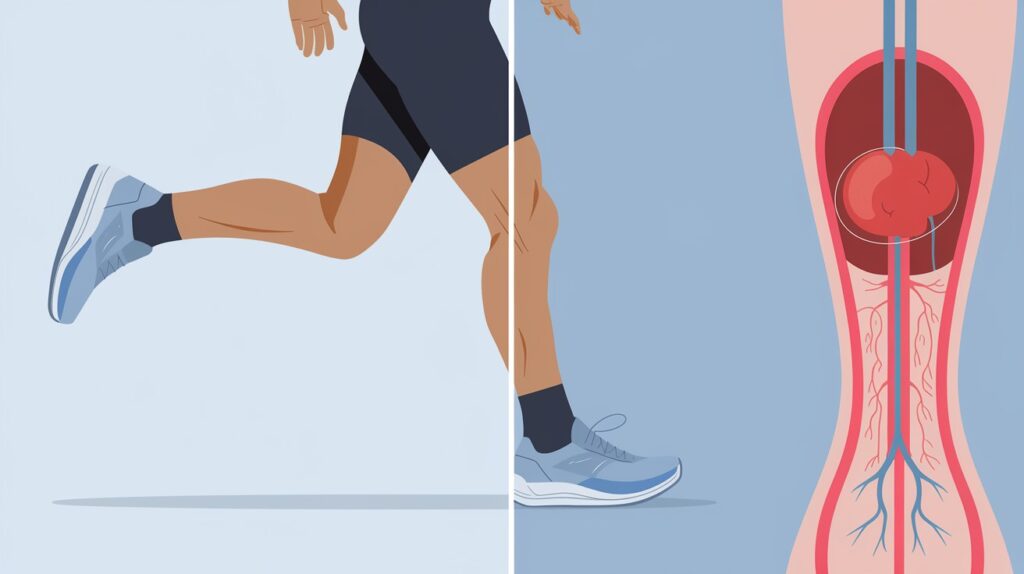
Athletes look like the picture of health, yet a substantial body of medical literature shows they are not immune to blood clots — and in some respects they face exposures the general population does not. A 2020 review in Blood Reviews examined venous thromboembolism (VTE), the medical term for a clot that forms in a deep vein and can break loose and travel to the lungs. For anyone who trains hard, understands their body well, and assumes fitness is protective, the findings are a useful corrective: being athletic lowers some risks while quietly raising others.
How common, and how serious
In the general population, VTE affects roughly 1 to 2 people per 1,000 each year. It is not a minor event. Across all patients, up to 30% die within a month of diagnosis, and up to half of survivors are left with long-term complications such as post-thrombotic syndrome, which causes chronic leg swelling and pain. Most of that burden falls on older people who already have other illnesses, but the lesson for athletes is straightforward: a clot is never something to train through or brush off as ordinary soreness.
The reason VTE is so dangerous is mechanical. A clot that forms in a deep vein of the leg or pelvis can remain there and cause local damage, or a fragment can dislodge, pass through the heart, and lodge in the pulmonary arteries. That is a pulmonary embolism, and a large one can be fatal within minutes. This is why speed of recognition matters more than almost any other factor.
Why athletes are not immune
Highly active people actually carry fewer of the classic risk factors — they tend to be leaner, have better cardiovascular function, and avoid the sedentary habits most associated with clotting. Yet the review highlights several exposures that athletes encounter unusually often: dehydration during long training sessions or events, which thickens the blood; frequent long-haul travel to competitions, where hours of immobility in a cramped seat slow venous return; injuries and the immobilization, casting, or surgery that follow them; and, in some cases, performance-enhancing substances that shift the body toward clotting.
There is also a subtler mechanism. Intense, prolonged exertion temporarily tips the body’s clotting balance toward coagulation as part of a normal protective response to microtrauma. In a healthy athlete this resolves quickly, but combined with dehydration, a recent flight, or a lower-limb injury, the individual risk factors can stack. Endurance athletes — marathoners, long-distance cyclists, triathletes — sit at the intersection of several of these exposures at once, particularly in the days around a big event when travel, dehydration, and extreme exertion coincide.
Warning signs worth knowing
The signs of a clot are easy to mistake for training strain, which is exactly what makes them dangerous for athletes. A clot in the leg (deep vein thrombosis) can cause swelling, aching or cramping pain, warmth, or redness — typically in just one calf or thigh rather than both. The asymmetry is a clue: ordinary post-training soreness is usually symmetrical, while a clot tends to affect one limb.
If part of the clot travels to the lungs, the symptoms change and escalate: sudden shortness of breath that is out of proportion to exertion, sharp chest pain that worsens with a deep breath, a racing or irregular heartbeat, light-headedness, or coughing. An athlete who assumes these are simply signs of a hard session or poor conditioning can lose critical time. The rule of thumb is that new, one-sided leg symptoms or unexplained breathlessness deserve medical attention rather than a rest day.
Who should be especially cautious
Certain situations raise an athlete’s risk enough to warrant extra vigilance. Recovering from a lower-limb injury or surgery, wearing a cast or boot, undertaking long-haul travel across multiple time zones, or returning to heavy training after illness all deserve attention. A personal or family history of clotting disorders matters a great deal, as inherited conditions such as Factor V Leiden are common and often silent until a triggering event. Female athletes using hormonal contraception carry a modestly higher baseline risk that combines with the athletic exposures above. None of these should stop anyone from training — but awareness changes how quickly a person acts when symptoms appear.
What to do
The most useful response to suspected blood clots is to seek medical care promptly rather than train through it. Diagnosis is quick and non-invasive — usually an ultrasound of the leg or imaging of the chest — and treatment is effective, but it is medically supervised and typically means a pause from sport while the clot is managed with anticoagulation. Trying to “push through” is the single most dangerous choice, because it gives a clot time to grow or travel.
Practical prevention is simple and worth building into any athlete’s routine: hydrate consistently around long sessions and events, move and stretch during long flights or drives, follow medical guidance carefully during injury recovery rather than sitting immobile, and treat any one-sided leg swelling or unexplained breathlessness as a reason to get checked. See also: more reads.
It is worth stressing that this is not a reason for athletes to fear training. Regular physical activity remains one of the strongest protectors of long-term cardiovascular and metabolic health. The point is narrower: fitness does not grant immunity from clots, and the very lifestyle of a competitive athlete — travel, dehydration, occasional injury — introduces specific, manageable risks. Knowing them turns a potentially serious event into one that is caught early and treated well.
Sources
The information in this article is for educational purposes only and does not substitute professional medical advice. If you suspect a blood clot, seek medical care promptly.
The Active Arabia weekly
One article built on one named study, every week, in your inbox. No noise.
We never share your email. Unsubscribe in one click.