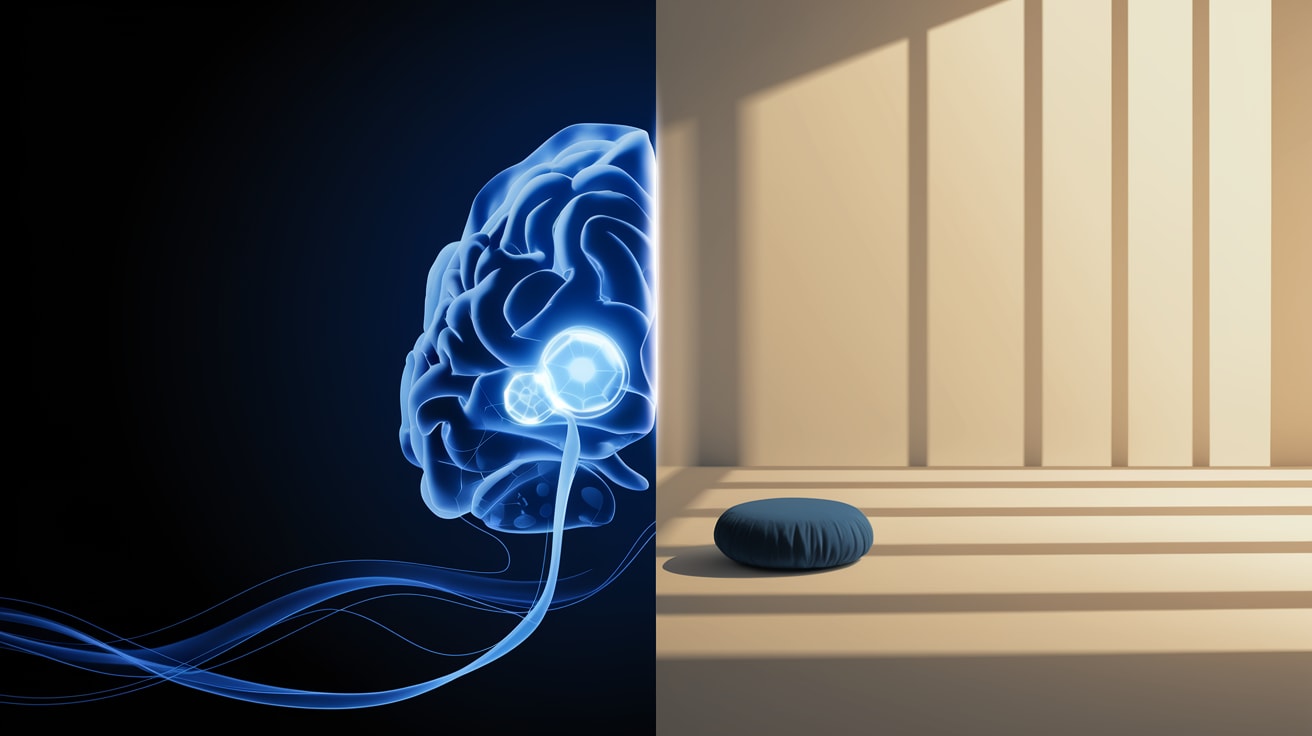
Mindfulness meditation brain changes are not just popular claims — they are scientifically verified findings. Functional MRI studies from Harvard University and Massachusetts General Hospital have revealed that just eight weeks of mindfulness meditation practice can measurably alter brain structure. But what exactly happens inside your brain when you sit down to meditate?
What Did the Harvard fMRI Studies Discover About Mindfulness Meditation Brain Changes?
In a landmark 2012 study, Dr. Sara Lazar and her colleagues at Massachusetts General Hospital used functional magnetic resonance imaging to scan participants’ brains before and after an eight-week mindfulness meditation program. The striking result: significant increases in cortical thickness in regions associated with memory, learning, and emotional regulation.
A separate study by Dr. Gaëlle Desbordes at the same institution demonstrated that changes in brain activity persist even when the person is not actively meditating. Using fMRI before-and-after scans over two months, she detected changes in the amygdala — the brain region responsible for fear and stress responses — after eight weeks of mindful attention meditation training. This was the first time such a change had been detected in this specific brain region.
A comprehensive 2026 scoping review published in Brain Sciences confirmed that mindfulness practice is associated with increases in gray matter density, gray matter volume, and cortical thickness across multiple brain regions.
How Does Mindfulness Meditation Physically Change the Brain?
The mechanism behind mindfulness meditation brain changes rests on neuroplasticity — the brain’s ability to reorganize itself and form new neural connections in response to repeated experiences and practices. When a person practices mindfulness meditation regularly, they train their brain to focus on the present moment and observe thoughts and emotions without judgment.
The Hölzel et al. 2011 study demonstrated that just eight weeks of a Mindfulness-Based Stress Reduction program led to increased gray matter concentration in four key brain regions: the hippocampus (responsible for learning and memory), the posterior cingulate cortex (associated with self-awareness), the temporo-parietal junction (linked to empathy and perspective-taking), and the cerebellum (involved in emotional regulation).
Simultaneously, fMRI studies have shown a reduction in amygdala volume — the region that activates in response to stress and anxiety. This means meditation doesn’t just strengthen positive brain areas; it structurally weakens the stress response itself.
Mindfulness Meditation and Mental Health: What Do the Numbers Show?
The number of randomized controlled trials on mindfulness jumped from just one study between 1995 and 1997 to a remarkable 216 trials between 2013 and 2015. These trials have demonstrated proven benefits for depression, anxiety, chronic pain, irritable bowel syndrome, fibromyalgia, psoriasis, and post-traumatic stress disorder.
Studies indicate that the effect size is moderate — comparable to other established treatments. As the Harvard researchers noted, mindfulness meditation is not a magic cure, but rather an effective tool within a comprehensive therapeutic framework.
In the Gulf region, where stress and anxiety rates are rising due to the pressures of modern fast-paced life, mindfulness meditation offers a practical, evidence-based solution. Research has shown that regular mindfulness practice can help improve sleep quality, reduce depression symptoms, and enhance overall psychological wellbeing.
Mindfulness-Based Stress Reduction: The Gold Standard Program
Jon Kabat-Zinn developed the Mindfulness-Based Stress Reduction program at the University of Massachusetts Medical Center in the 1970s, and it has since become the gold standard in scientific research and clinical application. The eight-week program includes weekly two to two-and-a-half-hour group training sessions, 45 minutes of daily individual practice, and a daylong retreat.
Mindfulness-Based Cognitive Therapy is a variation that incorporates elements of cognitive behavioral therapy and has shown particular effectiveness in preventing depression relapse.
Research Limitations: What You Should Know Honestly
Despite encouraging results, some studies suffer from small sample sizes. The Hölzel 2011 study included only 16 participants in the meditation group. The effect size is moderate, not large, meaning mindfulness meditation is not a replacement for medical treatment in severe cases.
There is also a challenge in defining “mindfulness meditation” itself, as dozens of practice variations exist, and effects may differ depending on the type, duration, and regularity of practice. Nevertheless, the overall direction of scientific evidence is encouraging and consistent.
Practical Takeaways: How to Start a Mindfulness Meditation Practice
- Start with five minutes daily of breath-focused attention, then gradually increase to 20 minutes
- Use established meditation apps like Headspace or Calm for initial guidance
- Commit to a regular daily practice for at least eight weeks to see measurable changes
- Practice in a quiet place away from distractions, ideally at the same time each day
- Don’t try to stop your thoughts — observe them without judgment, then redirect focus to breathing
- Consult a specialist if you experience severe psychological conditions before starting an intensive program
Related on Active Arabia: why five minutes of mindfulness a day is enough and evidence-based anxiety management techniques.
Sources
- Harvard Gazette: “When science meets mindfulness” — news.harvard.edu
- Rafter C, et al. “Mindfulness Practice and Increases in Gray Matter Density, Gray Matter Volume, and Cortical Thickness: A Scoping Review.” Brain Sciences, 2026 — mdpi.com
- Ruther S, Jackson E. “Mindfulness on the brain: a review of structural and functional MRI findings in MBSR.” European Journal of Radiology, 2025 — ejradiology.com
Disclaimer
This article is for educational purposes only and is not a substitute for professional medical advice. Studies suggest benefits of mindfulness meditation, but results vary from person to person. Consult a doctor or mental health professional before starting any new program, especially if you have an existing psychological condition.
The Active Arabia weekly
One article built on one named study, every week, in your inbox. No noise.
We never share your email. Unsubscribe in one click.