
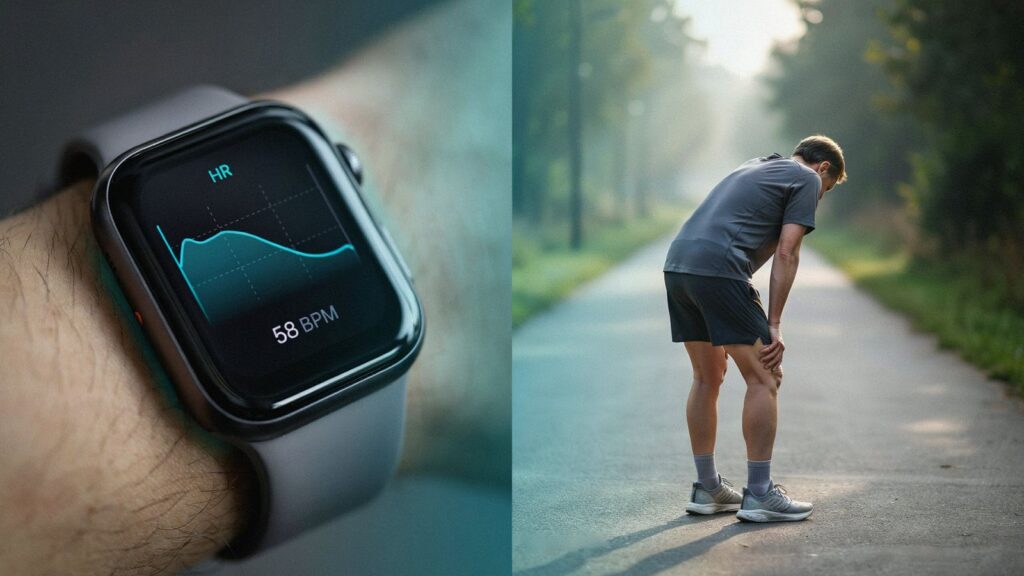
How quickly your heart rate drops after you stop exercising turns out to be one of the more powerful, and most overlooked, predictors of long-term health. A landmark 2017 meta-analysis published in the Journal of the American Heart Association pooled data from nine prospective studies and more than 41,000 participants to answer a question that had never been systematically assessed: does a slow heart rate recovery actually predict who develops heart disease or dies earlier — and by how much?
What Heart Rate Recovery Actually Measures
Heart rate recovery, or HRR, is simply the difference between your heart rate at peak exertion and your heart rate one or two minutes after you stop exercising. It’s a noninvasive window into how well your autonomic nervous system — the automatic control system governing your heart, digestion, and stress response — is functioning. A healthy heart drops quickly once exercise stops, driven by a fast return of parasympathetic (“rest and digest”) activity. A heart that stays elevated for longer reflects reduced parasympathetic tone and lingering sympathetic (“fight or flight”) dominance, a pattern researchers call autonomic dysfunction.
The Numbers Behind the Headline
The meta-analysis drew on five studies covering cardiovascular events — 1,061 cases among 34,267 participants — and nine studies covering all-cause mortality, spanning 2,082 deaths among 41,600 participants. The pooled result was striking in its consistency: for every 10 beats-per-minute decrease in heart rate recovery, the risk of a cardiovascular event rose by 13%, and the risk of death from any cause rose by 9%. Crucially, this association held independent of traditional risk factors like obesity, diabetes, and abnormal cholesterol levels — meaning slow heart rate recovery isn’t just a symptom of other known risks, it appears to carry meaningful predictive information of its own.
Why a Slow Recovery Matters Physiologically
The mechanism researchers point to centres on autonomic imbalance. When parasympathetic reactivation after exercise is sluggish, the heart spends more time under relatively higher sympathetic drive than it should. Over time, this pattern is linked to increased cardiac strain, greater susceptibility to dangerous heart rhythm disturbances, and a general state of heightened physiological stress on the cardiovascular system. It’s the same underlying nervous system imbalance that shows up, from a different angle, in research linking poor heart rate recovery to elevated risk of developing type 2 diabetes — reinforcing that this single, simple measurement reflects something genuinely systemic about how well the body regulates itself.
How It’s Actually Measured
The traditional and most extensively validated method uses heart rate recovery at one or two minutes after peak exertion, typically captured during a supervised exercise stress test. More recent research has also examined heart rate recovery at just 10 seconds post-exercise as a potentially even more sensitive early marker of autonomic function, though the one- and two-minute windows remain the gold standard with the strongest evidence base behind them. For someone without access to formal stress testing, a simpler practical version is achievable: note your heart rate at the peak of a hard exercise effort, stop, sit or stand still, and check your heart rate again after exactly one minute — a modern fitness tracker or a simple pulse count both work for this.
What a Healthy Recovery Looks Like
- Slow or concerning: A drop of less than roughly 12 beats per minute in the first minute after stopping exercise is generally considered an attenuated, less favourable recovery pattern in clinical research.
- Better recovery: A drop of 12 or more beats per minute in that first minute reflects healthier autonomic function, and larger drops generally reflect an even more favourable pattern.
- Trend matters more than one reading: A single measurement is a snapshot; tracking your own heart rate recovery over months as fitness changes gives a much more meaningful picture than comparing yourself to a generic cutoff.
Can You Actually Improve It?
Unlike some cardiovascular risk markers that are largely fixed, heart rate recovery is a trainable trait. Regular aerobic exercise — the same consistent, moderate-to-vigorous activity that improves overall cardiovascular fitness — reliably strengthens parasympathetic tone over time, and studies tracking heart rate recovery before and after structured training programs generally find measurable improvement within a matter of months. This makes HRR one of the more genuinely actionable numbers in cardiovascular health: unlike genetic risk factors, it responds directly to the kind of consistent physical activity that’s already recommended for general health, giving people a concrete, trackable signal of whether their training is actually improving how their heart functions, not just how it looks on the outside.
The core message from this research is simple and worth acting on: how fast your heart rate falls after exercise isn’t a trivial detail, it’s a genuine, independent signal of cardiovascular and overall health — and unlike many risk factors, it’s one you can meaningfully influence yourself, through the same consistent aerobic activity already known to protect long-term health. Whether you check it with a fitness tracker at home or as part of a formal stress test, it’s a number worth knowing and worth paying attention to over time.
Sources
- Heart Rate Recovery and Risk of Cardiovascular Events and All-Cause Mortality: A Meta-Analysis of Prospective Cohort Studies — Journal of the American Heart Association (2017)
- Heart Rate Recovery 10 Seconds After Cessation of Exercise Predicts Death — Journal of the American Heart Association (2018)
The information in this article is for educational purposes only and does not substitute professional medical advice. Consult your physician before beginning a new exercise program, particularly if you have existing cardiovascular risk factors.
The Active Arabia weekly
One article built on one named study, every week, in your inbox. No noise.
We never share your email. Unsubscribe in one click.