
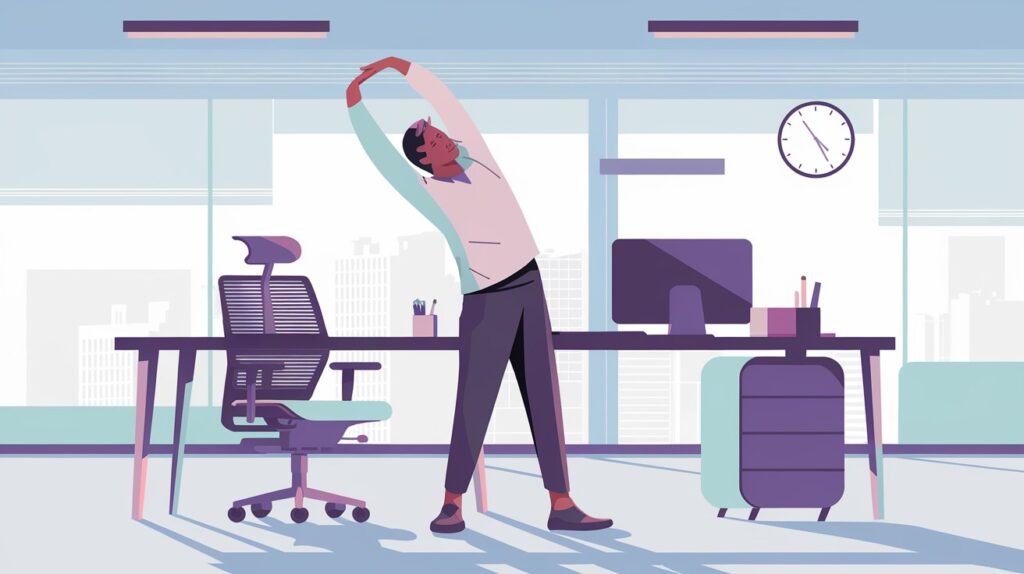
Daily movement breaks are the hidden health superpower most people ignore. If you work at a desk or sit for more than 6 hours daily, daily movement breaks stand between you and heart disease, diabetes, and metabolic dysfunction. Sitting continuously for longer than 2 hours straight begins to damage your cardiovascular system—even if you exercise after work.
Daily movement breaks: The science behind them
Recent research from medical institutions confirms that the average person now sits 7-8 hours daily in developed nations. This continuous sedentary time increases risk across all chronic diseases—heart disease, stroke, diabetes, obesity, and early mortality. But here’s the game-changer: short daily movement breaks work. Studies from Gulf-region universities prove that brief movement bouts (just 3-5 minutes every hour) cut all-cause mortality risk by 15-30%. The movement doesn’t need to be intense—standing, brisk walking, light stretching work powerfully. No gym required, no special equipment needed.
How daily movement breaks boost focus and productivity
Daily movement breaks are not just about physical health—they transform mental performance too. After 45+ minutes of continuous sitting, blood flow to your brain drops, oxygen delivery decreases, and focus collapses. The fix? Three minutes of movement every hour. Workplace studies show that employees taking regular movement breaks improve productivity by 10-20% and report 30% less fatigue. This is peer-reviewed science—and a direct investment in your work performance. Integrated healthy living embeds movement into every working hour.
Types of daily movement breaks that work
Not all movement is created equal. Effective daily movement breaks include:
• Standing instead of sitting for 2-3 minutes every hour = optimal for circulation
• Taking stairs instead of elevators = simultaneous calorie burn and leg strength
• Walking briskly to grab water or coffee = rapid blood and oxygen refresh
• Simple desk stretches = eliminate neck and lower-back pain
• Light jumping jacks or dance for 2 minutes = instant heart-rate elevation
Critical insight: distributed movement throughout the day beats occasional long workouts. Ten minutes of movement spread across 8 hours outperforms 30 minutes once daily—because your body needs continuous activation signals.
Practical action steps starting today
- Set a phone alarm every hour—when it rings, stand and move for 3 minutes
- Transition to a standing desk for half your workday (or a setup that encourages movement)
- Walk to a colleague instead of sending email
- Always choose stairs over elevators
- Perform 20 jumping jacks or basic stretches every 2 hours
- Track your mood and focus—notice the improvement within one week
Bottom line
Daily movement breaks are not optional—they’re as essential as sleep and nutrition. Your body was not engineered for 8 hours of continuous sitting. Frequent small movement pulses protect your heart, strengthen your brain, and elevate your work output. Don’t wait for the weekend to move. Make your daily life a sequence of constant movement—three minutes every hour changes everything.
Sources
- PubMed Central: Sedentary behavior and health risks—epidemiological evidence
- MDPI Nutrients: Movement frequency, metabolic health, and cardiovascular outcomes
- PubMed Central: Workplace movement interventions and productivity gains
The information in this article is for educational purposes only and does not substitute professional medical advice.
The Active Arabia weekly
One article built on one named study, every week, in your inbox. No noise.
We never share your email. Unsubscribe in one click.