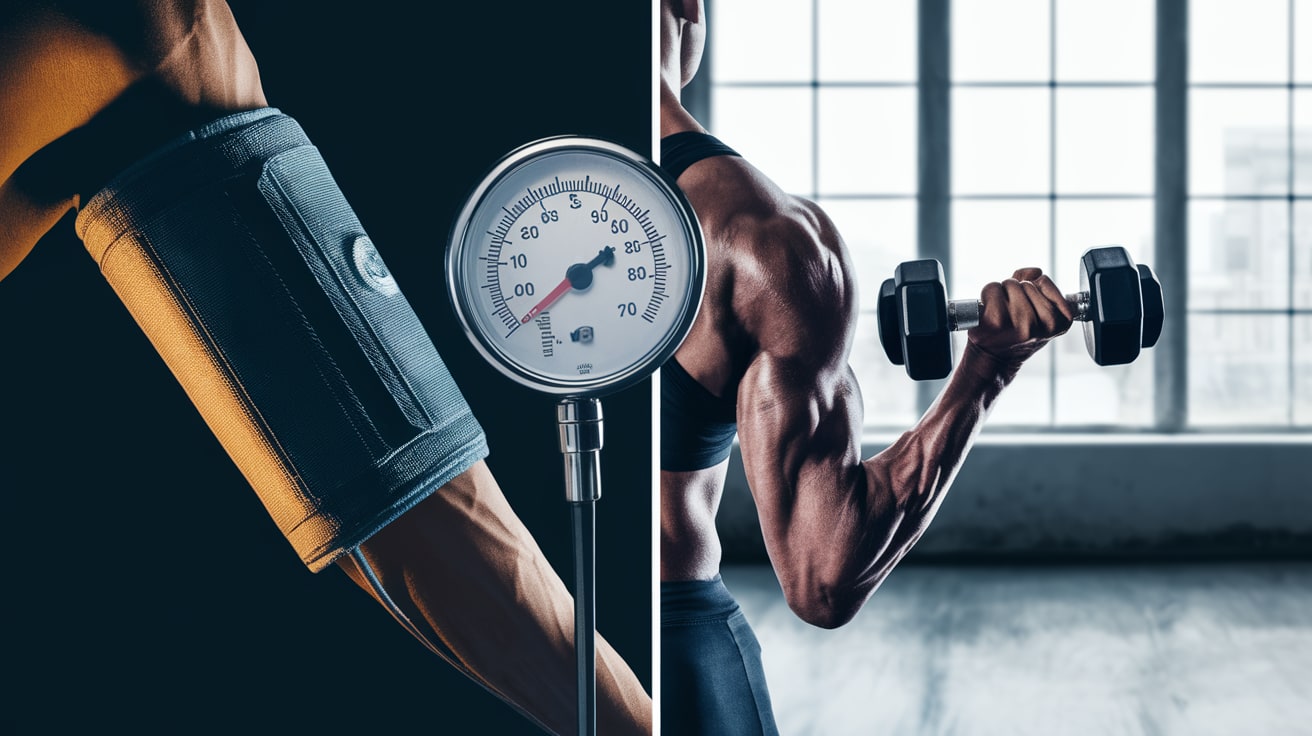
Blood flow restriction training can build muscle strength and size with light weights — but it won’t make you jump higher or sprint faster. A 2026 meta-analysis published in Frontiers in Physiology, pooling 12 randomized controlled trials with 859 team-sport athletes, found that adding blood flow restriction training to resistance exercise produced a small-to-moderate improvement in muscle strength (SMD = 0.42, p < 0.001) and a small but significant gain in muscle hypertrophy (SMD = 0.32, p = 0.02). However, there was no significant effect on jump performance (SMD = 0.12, p = 0.49) or sprint speed (SMD = 0.07, p = 0.65).
What Is Blood Flow Restriction Training?
Blood flow restriction training involves placing a specialized cuff or band on the upper or lower limbs to partially restrict venous blood return during exercise. The concept is straightforward: reduce the blood leaving the working muscle while maintaining arterial inflow, creating a unique metabolic environment inside the tissue.
The protocol typically uses light loads of 20% to 50% of one-rep max (1RM), compared to the 65%+ loads required for traditional hypertrophy training. This makes it especially appealing for athletes recovering from injury, older adults, or anyone seeking to reduce joint and tendon stress while maintaining training stimulus.
Cuff pressures in the research literature range from 130 to 230 mmHg, or are calculated as a percentage of arterial occlusion pressure (AOP), typically 40%–80% for lower limbs and 40%–60% for upper limbs. Cuff widths vary between 5 and 10.5 cm, with wider cuffs generally requiring lower pressures.
The Physiology: How Does Blood Flow Restriction Build Muscle?
The effectiveness of blood flow restriction training rests on several interconnected physiological mechanisms. First, metabolite accumulation: when venous return is restricted, anaerobic byproducts like lactate and hydrogen ions accumulate within the muscle tissue. This buildup recruits fast-twitch (Type II) muscle fibers that are normally only activated under heavy loads.
Second, growth hormone secretion increases dramatically — up to 290 times baseline levels, according to landmark research by Pearson and Hosman (2005). The training also activates the mTOR cellular pathway responsible for muscle protein synthesis, even in the absence of heavy mechanical loading.
Third, cell swelling occurs as fluid is trapped within the muscle. This swelling is an independent stimulus for protein synthesis and an inhibitor of protein breakdown. Together, these mechanisms explain how light loads can produce hypertrophic results that approach those of heavy-load training.
What the 2026 Meta-Analysis Found
Huang and colleagues published their systematic review and meta-analysis in Frontiers in Physiology in July 2026. The analysis included 12 randomized controlled trials with 859 team-sport athletes aged 16.3 to 25 years, competing in football (soccer), volleyball, basketball, netball, and rugby. Study quality was rated using the PEDro scale, with a mean score of 7.25 out of 10.
For muscle hypertrophy, the pooled analysis of 7 studies (242 participants, 11 outcomes) showed a standardized mean difference of 0.32 (95% CI: 0.05 to 0.58, p = 0.02) with low heterogeneity (I² = 4%). For muscle strength, 9 studies (311 participants, 13 outcomes) produced an SMD of 0.42 (95% CI: 0.18 to 0.66, p < 0.001) with similarly low heterogeneity (I-squared = 10%).
The critical finding was what blood flow restriction training did not improve. Jump performance across 7 studies (139 participants) showed an SMD of just 0.12 (95% CI: −0.22 to 0.46, p = 0.49). Sprint performance across 5 studies (167 participants) was equally unimpressive at SMD = 0.07 (95% CI: −0.38 to 0.24, p = 0.65). Egger’s tests confirmed no publication bias for any outcome.
Blood Flow Restriction vs Heavy Lifting: The Comparison
Previous research has shown that blood flow restriction training can achieve strength gains comparable to heavy-load resistance training while imposing significantly less mechanical stress on joints. A 2024 meta-analysis by Ma and colleagues in Frontiers in Physiology confirmed that low-load blood flow restriction training improved muscle strength and thickness in young adults similarly to traditional heavy-load training.
However, the effect sizes tell a nuanced story. Huang’s SMD of 0.42 for strength was lower than the 0.99 reported by Li et al. (2025) for maximal strength in mixed-sport athletes — but Li’s study had high heterogeneity (I² = 68%), while Huang’s showed only 10%. Lower heterogeneity means more consistent, reliable results across studies.
An important caveat: most studies in Huang’s analysis used loads between 20% and 50% of 1RM, with only one study using 70% 1RM. The proven effectiveness therefore applies primarily to low-to-moderate load blood flow restriction protocols, not heavy-load combinations.
Where Blood Flow Restriction Falls Short
The non-significant effects on jumping (SMD = 0.12) and sprinting (SMD = 0.07) reveal clear boundaries. Explosive performance depends on the nervous system’s ability to rapidly recruit muscle fibers and coordinate complex movement patterns — skills that blood flow restriction training does not directly develop.
The physiological explanation is that blood flow restriction primarily stimulates metabolic and hormonal adaptations linked to hypertrophy and strength, but does not replicate the neuromechanical demands of jumping and sprinting. If your athletic goal requires explosive power, blood flow restriction should complement — not replace — plyometric and speed training.
This aligns with previous findings about plyometric exercise performance, where jump tests may not accurately measure strength gains, and each training modality targets specific adaptations.
How to Apply Blood Flow Restriction Training Safely
If you decide to try blood flow restriction training, here are evidence-based guidelines drawn from the protocols used across the meta-analysis studies. Frequency: 2 to 3 sessions per week. Duration: 4 to 8 weeks. Load: 20% to 50% of 1RM. Rep scheme: the most common protocol is 30-15-15-15 repetitions with 30 seconds rest between sets.
Critical safety warnings: never use improvised wraps or elastic bands not designed for this purpose — they can cause nerve damage or completely occlude arterial flow. Invest in purpose-built blood flow restriction cuffs, 5–10 cm wide. Do not exceed 60 minutes of continuous training with cuffs applied. Stop immediately if you experience numbness, tingling, or color changes in the limbs.
Blood flow restriction training is an excellent option within fitness and training programming for athletes recovering from injury, those managing joint pain, or as a supplementary stimulus during deload weeks. It is not a magic replacement for traditional training — it is a specialized tool in the training toolbox.
Practical Takeaways
• Blood flow restriction training improves muscle strength (SMD = 0.42) and hypertrophy (SMD = 0.32) in team-sport athletes, per a 2026 meta-analysis of 859 athletes across 12 trials.
• Jump and sprint performance showed no significant improvement — BFR does not directly enhance explosive power.
• Effective protocols use light loads (20%–50% of 1RM), 2–3 sessions per week, for 4–8 weeks.
• Ideal for injury rehabilitation and reducing joint stress, but not a replacement for heavy-load or plyometric training.
• Use purpose-built cuffs only — improvised wraps risk nerve damage and arterial occlusion.
Sources
Huang Q, Xiao L, Zheng S, Meng L, Yue S. “Muscle hypertrophy and strength improvements following blood flow restriction combined with resistance training in team-athletes: a systematic review and meta-analysis.” Frontiers in Physiology. 2026;17:1812707. doi:10.3389/fphys.2026.1812707.
Ma F, He J, Wang Y. “Blood flow restriction combined with resistance training on muscle strength and thickness improvement in young adults: a systematic review, meta-analysis, and meta-regression.” Frontiers in Physiology. 2024;15:1379605. doi:10.3389/fphys.2024.1379605.
Geng Y, Wu X, Zhang Y, Zhang M. “Potential moderators of the effects of blood flow restriction training on muscle strength and hypertrophy: a meta-analysis based on a comparison with high-load resistance training.” Sports Medicine – Open. 2024;10:55. doi:10.1186/s40798-024-00719-3.
The Active Arabia weekly
One article built on one named study, every week, in your inbox. No noise.
We never share your email. Unsubscribe in one click.