
If you are hitting your daily protein target but still struggling to build muscle, the problem may not be how much protein you eat — it may be when you eat it. The concept of protein distribution meals — spreading your daily protein intake evenly across three to four meals rather than loading it all at dinner — has gained strong support from recent peer-reviewed research. A 2026 narrative review published in Sports Health by Vergara Nieto and colleagues, along with a 2025 literature review by Jeong in Cureus, both converge on the same conclusion: distributing protein evenly across meals at roughly 0.4–0.5 g per kilogram of body weight per meal maximizes muscle protein synthesis far better than a skewed pattern where most protein arrives in a single large meal.
Why Protein Timing Matters: The Muscle Full Effect
Skeletal muscle has a ceiling on how much protein it can use for building in a single sitting. Researchers call this the “muscle full” effect. When you consume more than approximately 0.4 g/kg of high-quality protein in one meal, the excess amino acids are oxidized for energy or redirected to other tissues rather than being incorporated into muscle. A 2025 review by Jeong in Cureus found that distributing protein at approximately 0.25 g/kg per meal in younger adults and 0.40 g/kg per meal in older adults effectively overcomes what is known as “anabolic resistance” — the age-related blunting of the muscle-building response to food.
This means a 75 kg adult would benefit most from roughly 25–30 g of protein per meal, consumed three to four times per day. The 2026 Sports Health review by Vergara Nieto et al. confirmed that this pattern of 3–4 meals at approximately 0.4–0.5 g/kg/meal sustains anabolic signaling throughout the day more effectively than two large protein-heavy meals.
The Science Behind Even Distribution
The mechanism centers on a molecular pathway called mTORC1 (mammalian target of rapamycin complex 1). When essential amino acids — particularly the branched-chain amino acid leucine — appear in the bloodstream after a protein-rich meal, they activate mTORC1, which triggers muscle protein synthesis. However, this activation is transient: levels peak roughly 60–90 minutes after eating and then return to baseline, even if amino acids remain elevated in the blood. Jeong’s 2025 review noted that “leucine-rich, rapidly absorbed sources such as whey elicit the most robust mTOR activation and muscle-building response.”
By spacing protein-rich meals approximately 3–5 hours apart, you create repeated waves of mTORC1 activation rather than one massive spike followed by a long refractory period. The Vergara Nieto review concluded that this approach, combined with total daily protein of approximately 1.6 g/kg/day (and up to 2.2 g/kg/day in trained athletes), provides the most evidence-informed nutritional framework for hypertrophy.
Practical Application: What a Protein-Optimized Day Looks Like
Translating the research into a practical eating plan is straightforward. For a 70 kg person targeting 1.6 g/kg/day (112 g total), an optimized distribution would look like:
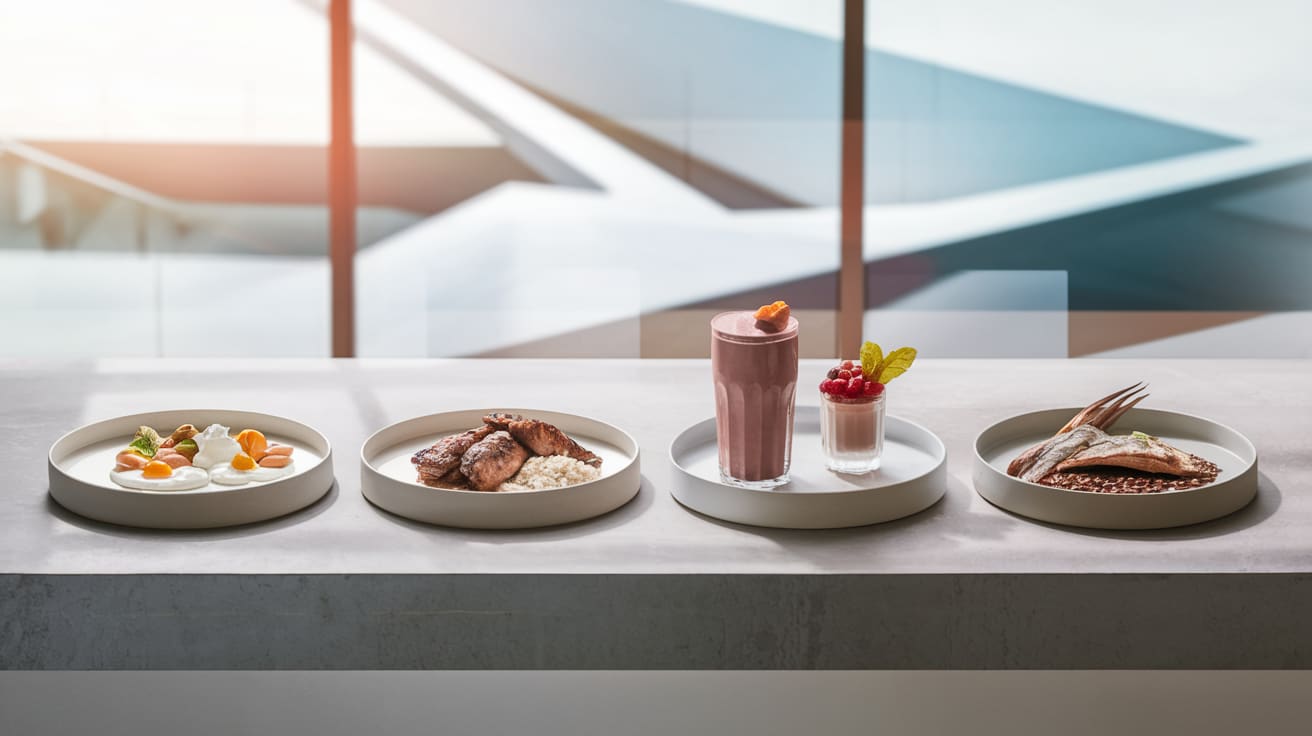
- Breakfast (7–8 AM): 28 g protein — three eggs with Greek yogurt and a handful of nuts
- Lunch (12–1 PM): 28 g protein — grilled chicken breast with rice and vegetables
- Post-workout or afternoon snack (3–4 PM): 28 g protein — whey protein shake with a banana, or a serving of labneh with whole-grain bread
- Dinner (7–8 PM): 28 g protein — fish or lean meat with lentils and a side salad
Each meal delivers approximately 0.4 g/kg, hitting the per-meal leucine threshold that research shows is necessary to fully stimulate muscle protein synthesis. The Vergara Nieto review specifically recommended this 3–4 meal pattern as a “practical strategy to sustain anabolic signaling.”
Common Mistakes in the Gulf Region
In Saudi Arabia and the wider Gulf, eating patterns often skew protein heavily toward dinner. A typical day might include a light breakfast of tea and bread, a moderate lunch, and then a large dinner featuring an entire chicken or a substantial portion of meat. While total protein intake may be adequate, this back-loaded pattern means the body missed multiple anabolic windows during the day.
Another common pattern is skipping breakfast entirely and consuming two very large meals. The research is clear: this approach leaves significant muscle-building potential on the table. Even a modest protein addition to breakfast — such as adding eggs, labneh, or a protein shake — can meaningfully improve daily muscle protein synthesis rates.
Protein Quality: Not All Sources Are Equal
The research emphasizes that protein quality matters alongside distribution. Jeong’s 2025 review highlighted that leucine content is the key differentiator: animal proteins (whey, eggs, chicken, fish) contain higher leucine per gram than most plant proteins. For those following plant-based diets, combining legumes with grains (such as lentils with rice, a staple in Gulf cuisine) improves the amino acid profile and helps reach the leucine threshold per meal.
The Vergara Nieto review noted that energy availability and carbohydrate intake also play a supporting role, recommending approximately 3–6 g/kg/day of carbohydrates to fuel training performance and support the glycogen-dependent workload that drives hypertrophy.
Limitations and Honest Caveats
It is important to note that both reviews are narrative literature reviews, not new randomized controlled trials. The specific per-meal thresholds (0.25–0.5 g/kg) are derived from pooling data across multiple smaller studies, and individual responses vary based on training status, age, and genetics. The 2026 review acknowledged that recovery and sleep aspects still need more Level 1 evidence specifically tied to hypertrophy outcomes. Total daily protein remains the foundation — distribution optimizes on top of that foundation but cannot compensate for an overall deficit.
Practical Takeaways
- Aim for 3–4 protein-containing meals per day rather than one or two large ones
- Target approximately 0.4 g/kg of protein per meal (roughly 25–35 g for most adults)
- Prioritize leucine-rich protein sources such as eggs, whey, chicken, and fish at each meal
- Do not skip breakfast protein — even a modest 20–25 g serving activates an early anabolic window
- Space meals 3–5 hours apart to allow repeated mTORC1 activation cycles
- Total daily protein of 1.6 g/kg/day remains the foundation; distribution optimizes on top of it
Sources
- Vergara Nieto ÁA, Halabi Diaz A, Hernández Millán M, Sagredo Oyarzo D. “Molecular Basis and Practical Applications of Training, Nutrition and Recovery for Maximum Gains in Lean Muscle Mass.” Sports Health, 2026. DOI: 10.1177/19417381261438760
- Jeong SY. “The Role of mTOR and AMPK Signaling in Skeletal Muscle Hypertrophy.” Cureus, 2025;17(11):e96018. DOI: 10.7759/cureus.96018
Disclaimer: This article is for educational purposes only and does not constitute medical or nutritional advice. Consult a qualified healthcare professional or registered dietitian before making significant changes to your diet or exercise routine.
The Active Arabia weekly
One article built on one named study, every week, in your inbox. No noise.
We never share your email. Unsubscribe in one click.