
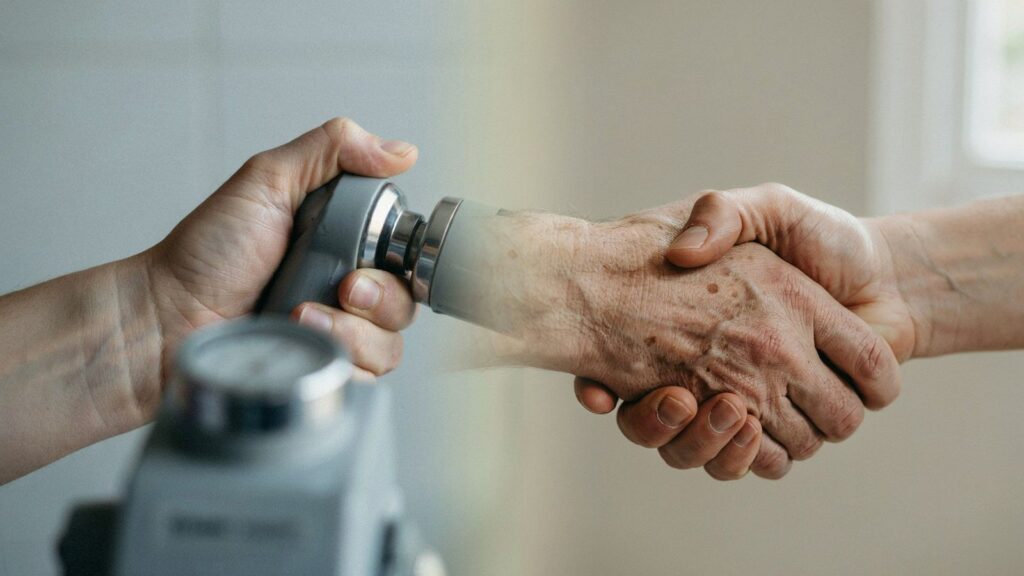
One of the most powerful predictors of how long you’ll live doesn’t require a blood test, a scan, or a doctor’s visit. It requires a simple squeeze. Grip strength — the force you can generate with one hand around a handheld device called a dynamometer — has emerged over the past decade as one of the most consistently validated biomarkers in longevity science, and the scale of the research behind it is genuinely remarkable: millions of participants, tracked across continents, all pointing in the same direction.
The Scale of the Evidence
A landmark 2015 analysis published in The Lancet, led by researcher Darryl Leong, pooled data from 139,691 people across 17 countries on six continents. The finding was striking in its consistency: every 5-kilogram decrease in grip strength was associated with a 16% higher risk of death from any cause, a 17% higher risk of cardiovascular death, and an 11% higher risk of stroke — and grip strength turned out to be a stronger predictor of cardiovascular events than systolic blood pressure, one of medicine’s most established risk markers. A follow-up 2018 study published in the BMJ, drawing on nearly half a million UK Biobank participants, reached the same conclusion: adding grip strength to a standard clinical risk score meaningfully improved prediction of all-cause mortality and cardiovascular disease, and grip strength outperformed both blood pressure and total physical activity level as a predictor.
Beyond the Heart: Cognitive and Cancer Links
The associations extend well beyond cardiovascular health. A UK Biobank study following 466,788 participants found that people in the lowest fifth of grip strength had a 72% higher risk of developing dementia and an 87% higher risk of dying from it, compared with those in the strongest fifth — and the researchers estimated that roughly 30% of dementia cases and 32% of dementia deaths in the study population were statistically attributable to low grip strength. Separate UK Biobank research involving over 445,000 participants found associations between grip strength and several cancer outcomes, and other research has linked weaker grip specifically to higher breast cancer mortality risk in women. None of this means grip strength directly causes these conditions — it’s better understood as a window into overall muscular and physiological health, a single measurement that reflects years of accumulated fitness, nutrition, and biological aging.
Why a Hand Squeeze Reflects So Much
Grip strength isn’t really about hand muscles in isolation. It’s widely used as a practical surrogate for overall skeletal muscle mass and function, since the forearm flexors respond to the same physiological processes — muscle protein synthesis, neuromuscular efficiency, hormonal balance — that govern strength throughout the body. Because it’s measured with a standardized tool, the Jamar hydraulic dynamometer considered the gold standard in medical research, grip strength gives researchers an unusually clean, comparable number across huge populations — which is part of why it has become such a heavily studied biomarker: it’s cheap, fast, noninvasive, and remarkably consistent.
What Counts as Strong
Research generally identifies a threshold effect: increases in grip strength up to around 42 kilograms in men and 25 kilograms in women are associated with meaningfully lower mortality risk, with diminishing additional benefit beyond that range. There’s also an interesting asymmetry finding worth knowing: a UK Biobank study of over 308,000 participants found that a significant strength difference between the dominant and non-dominant hand was itself linked to higher frailty and mortality risk, independent of overall grip strength — suggesting that balanced strength across both sides of the body may matter, not just the peak number from your stronger hand.
Testing and Tracking Your Own Grip Strength
- Get a baseline reading: A hydraulic hand dynamometer is inexpensive and widely available; testing both hands and averaging the result mirrors how the major research studies measure it.
- Test periodically, not obsessively: Monthly checks are plenty for general tracking; more frequent testing adds little value unless you’re in a structured rehabilitation or strength program.
- Watch the trend over years, not days: Grip strength typically peaks in your 30s and gradually declines afterward, with the decline accelerating past 60 — tracking your own trajectory matters more than comparing a single reading to a population average.
- Pair it with other markers: Grip strength complements, rather than replaces, other health metrics like blood pressure or cardiovascular fitness measures such as VO2max — it’s one strong signal among several worth tracking.
Building Grip Strength — and What It Represents
The encouraging part of this research is that grip strength, like most measures of muscular strength, responds to training. Regular resistance exercise — compound lifts that load the hands and forearms, dedicated grip work like farmer’s carries or hangs, and general strength training — reliably builds and maintains grip strength over time. But the deeper value of tracking it isn’t really about the number itself; it’s a proxy for something larger: whether your overall strength and muscle health are being maintained or eroded as you age. Improving your grip strength, in that sense, is really about the broader habit of strength training itself — and grip strength simply happens to be one of the easiest, cheapest ways to measure whether that habit is working.
Few single measurements pack this much predictive information into thirty seconds and a simple squeeze. Grip strength won’t replace a full medical checkup, but as a fast, low-cost signal of how well your body is aging, it’s earned its place as one of the more genuinely useful numbers in modern preventive health.
Sources
- Prognostic Value of Grip Strength: Findings from the Prospective Urban Rural Epidemiology (PURE) Study — The Lancet (2015)
- Associations of Grip Strength with Cardiovascular, Respiratory, and Cancer Outcomes and All-Cause Mortality — BMJ (2018)
- Handgrip Strength and All-Cause Dementia Incidence and Mortality — UK Biobank Prospective Cohort Study
The information in this article is for educational purposes only and does not substitute professional medical advice.
The Active Arabia weekly
One article built on one named study, every week, in your inbox. No noise.
We never share your email. Unsubscribe in one click.