Sun protection and skin care in Saudi Arabia extends beyond cosmetics—it is a medical necessity backed by decades of dermatological research. Studies show that daily sunscreen use reduces melanoma risk by 50%, yet a 2026 national study of 11,000 Saudis revealed that only 9.9% apply sunscreen consistently during outdoor activity, while 72.7% do not know their product’s SPF level. This gap between knowledge and practice drives preventable skin damage across the Kingdom. Understanding sun protection and skin care science can help close this gap and protect your skin for decades.
How Ultraviolet Radiation Damages Skin
Ultraviolet (UV) radiation from sunlight penetrates the skin’s outer layers and causes cumulative DNA damage in skin cells. This damage manifests in three forms: premature aging (wrinkles, dark spots, loss of elasticity), sunburn (acute inflammation), and skin cancer (uncontrolled cell growth). The American Academy of Dermatology explains that every time skin is exposed to UV light, damage occurs—even if you cannot see it immediately. The body can repair some of this damage, but repeated exposure overwhelms repair mechanisms, leading to permanent changes.
Saudi Arabia’s geographic location near the equator means residents experience higher UV intensity for longer periods than most temperate regions. Research published in Nature Scientific Reports documented that the Middle East and North Africa region records an age-standardized nonmelanoma skin cancer incidence of approximately 6.7 per 100,000 people annually, with basal cell carcinoma accounting for 26.3% of cases and squamous cell carcinoma around 41.1%. These numbers underscore why sun protection and skin care must be daily habits, not seasonal afterthoughts.
The Melanin Myth: Why Darker Skin Still Needs Protection
A dangerous misconception persists that darker skin tones do not require sunscreen. While melanin does provide some natural protection—roughly equivalent to SPF 13 to 15—this is far below the SPF 30 minimum dermatologists recommend, and nowhere near sufficient for Middle Eastern sun intensity. The American Academy of Dermatology emphasizes that anyone can develop skin cancer regardless of skin tone, and people with darker skin are often diagnosed at later stages when treatment is more difficult.
Research shows that adults under 30 and men in particular report higher UV exposure without proportionally higher protective behavior. This demographic gap matters because cumulative UV damage from youth manifests as skin cancer decades later. The evidence is clear: every skin type, regardless of pigmentation, remains vulnerable to sun damage, premature aging, and skin cancer without proper protection.
Sun Protection and Skin Care: Getting the Basics Right
Effective sun protection requires understanding three factors: SPF level, application amount, and reapplication frequency. The American Academy of Dermatology recommends broad-spectrum sunscreen with SPF 30 or higher for daily use, and SPF 50 or higher for extended outdoor activity. “Broad spectrum” means the product protects against both UVA rays (which cause aging and penetrate glass) and UVB rays (which cause burning). Both types contribute to skin cancer.
Application amount matters more than most people realize. SPF ratings are based on applying 2 milligrams per square centimeter of skin—roughly one teaspoon for the face and neck, and two tablespoons for full body coverage. Most people apply only 25-50% of this amount, which dramatically reduces actual protection. A 2023 study in the Journal of the American Academy of Dermatology found that using half the recommended amount reduces SPF protection by the square root of the dilution factor—meaning SPF 30 applied sparingly may provide only SPF 5-7 in practice.
Reapplication is equally critical. Sunscreen effectiveness degrades with time, sweat, and water exposure. Even water-resistant formulas typically hold up for only 40-80 minutes in water before needing reapplication. The American Academy of Dermatology recommends reapplying every two hours during extended outdoor time, and immediately after swimming or heavy sweating.
Physical Protection: Beyond Sunscreen
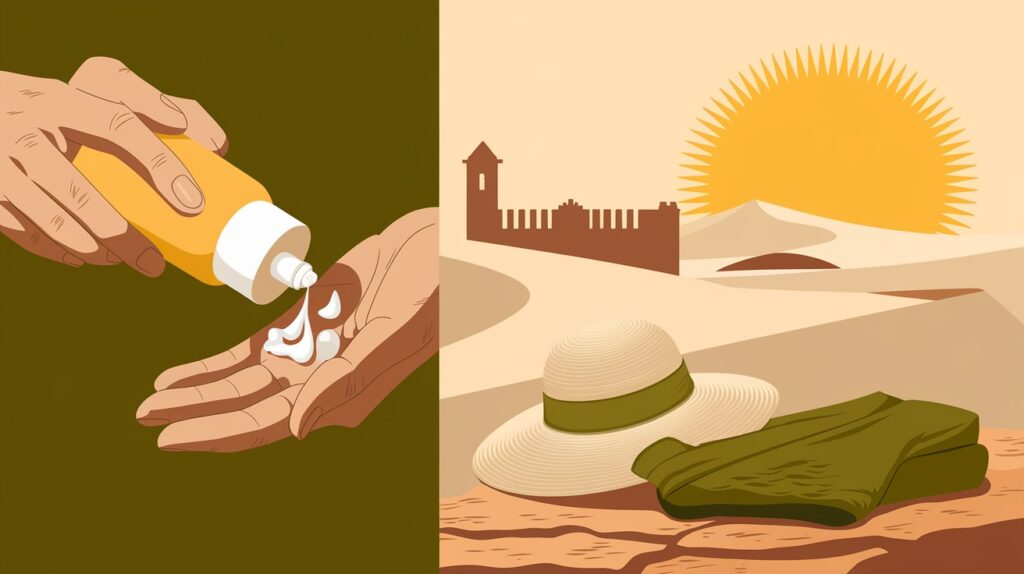
Sunscreen alone cannot provide complete protection. The American Academy of Dermatology recommends a layered approach: seeking shade during peak UV hours (10 AM to 4 PM), wearing protective clothing with UPF ratings, wide-brimmed hats, and UV-blocking sunglasses. Remember that UV rays reflect off sand, water, and concrete, increasing exposure even in shaded areas.
For those exercising outdoors in Saudi Arabia’s heat, protective clothing serves dual purposes: sun protection and heat management. Lightweight, long-sleeved shirts with UPF 50+ ratings block 98% of UV rays while allowing sweat evaporation. This approach is particularly important during Ramadan, when outdoor activity often occurs during daylight hours despite fasting-related dehydration.
Children and Sun Protection: Building Lifelong Habits
Childhood sun exposure has outsized impact on lifetime skin cancer risk. Research shows that five sunburns between ages 15 and 20 increase nonmelanoma skin cancer risk by 68% and melanoma risk by 80%. The American Academy of Dermatology recommends keeping infants under six months out of direct sunlight entirely, using shade and protective clothing rather than sunscreen. For older children, the same principles apply as for adults—broad-spectrum SPF 30 or higher, generous application, and frequent reapplication—but children need supervision since they rarely reapply independently.
Building sun-safe habits early creates lasting behavior. Normalizing hats, sunglasses, and shade-seeking as part of outdoor play carries through into adulthood. Schools and sports clubs in Saudi Arabia can play a crucial role by scheduling outdoor activities outside peak UV hours and providing shaded areas for recess and training.
Practical Sun Protection and Skin Care Steps
- Choose broad-spectrum SPF 30+ for daily use, SPF 50+ for extended outdoor exposure—check expiration dates, as sunscreen loses effectiveness after one year
- Apply one teaspoon to face and neck, two tablespoons to full body—most people need 2-3 times more than they currently use
- Reapply every two hours outdoors, immediately after swimming or heavy sweating—set a timer if needed
- Wear UPF-rated clothing, wide-brimmed hats, and UV-blocking sunglasses for layered protection
- Seek shade between 10 AM and 4 PM when UV intensity peaks—remember that clouds block only 20% of UV radiation
- Support skin recovery after exposure with hydrating moisturizers and antioxidant-rich products to counter oxidative stress
Sources
- American Academy of Dermatology. “Skin cancer: Symptoms, diagnosis, and causes.” Updated July 2026. https://www.aad.org/public/diseases/skin-cancer
- Silva ESD, Tavares R, Paulitsch FDS, Zhang L. “Use of sunscreen and risk of melanoma and non-melanoma skin cancer: a systematic review and meta-analysis.” European Journal of Dermatology. 2018;28(2):186-201. https://doi.org/10.1684/ejd.2018.3251
- Neale RE, Khan SR, Lucas RM, et al. “The effect of sunscreen on vitamin D: a review.” British Journal of Dermatology. 2019;181(5):907-915. https://doi.org/10.1111/bjd.17980
The information in this article is for educational purposes only and does not replace consultation with a board-certified dermatologist.
For more on managing outdoor activity in Saudi Arabia’s climate, see our guide to heat acclimation for athletes. Learn more about training in heat safely.
The Active Arabia weekly
One article built on one named study, every week, in your inbox. No noise.
We never share your email. Unsubscribe in one click.