
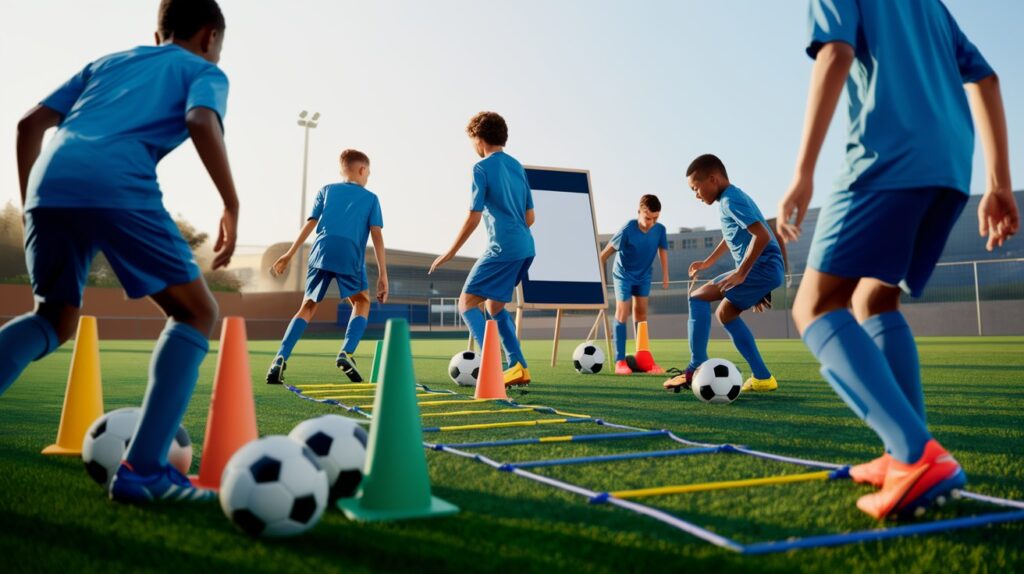
Youth football training has moved well beyond basic ball drills. Modern approaches build physically explosive, tactically intelligent, and mentally resilient young players by combining conditioning, cognitive challenge, and technical mastery in an integrated system. Recent sport-science research points to a consistent theme: young players who train under programs that combine physical conditioning with decision-making challenges develop faster, more adaptable skills than those who train ball control and fitness separately.
Why Combining Physical and Cognitive Training Works
A growing body of research on dual-task training—where players face physical and cognitive demands at the same time, such as controlling the ball while responding to a call or reading a teammate’s position—has found that this combined approach improves technical execution, physical output, and tactical decision-making together, more effectively than training these qualities in isolation. The underlying logic is intuitive once you see it: football itself is never just physical or just cognitive. A player is always moving, assessing, and deciding simultaneously, so training that reflects that reality builds skills that transfer more directly to the match. Separately, research on GPS and motion-tracking technology in youth academies shows that objective data on sprint speed, distance covered, and work-to-rest ratios helps coaches give more precise, individualized feedback than observation alone allows—accelerating the pace at which technical adjustments stick.
Benefits That Extend Beyond the Pitch
The value of structured youth football training reaches well past match performance. Youth sport researchers have consistently found that young athletes in structured, well-coached programs tend to show improved decision-making under pressure, greater self-confidence in high-stakes situations, and stronger peer relationships and team cohesion compared to less structured environments. There is also a cognitive dimension worth taking seriously: the visual-spatial awareness and split-second decision-making that football demands share underlying mechanisms with executive function skills used in other areas of life, including academics. None of this means football training is a substitute for other forms of development—but well-run programs consistently produce young people who carry confidence, discipline, and emotional regulation skills well beyond the sport itself.
Core Components of Effective Youth Training
- Plyometric and sprint conditioning: Jumping, bounding, and short-burst sprint work build explosive power and the ability to change direction quickly—both central to modern football. Two to three dedicated sessions weekly, with adequate recovery between them, is a common and sensible starting structure.
- Dual-task training: Combining physical execution with a decision or reaction (responding to a call, reading a defender, adjusting to a cue) trains the brain and body together, closer to how the skill will actually be used in a match.
- Technical ball mastery: Deliberate, focused practice of passing accuracy, first touch, and problem-solving on the ball—prioritizing quality repetitions over sheer volume.
- Objective performance tracking: Where available, GPS and motion data on speed, distance, and effort give coaches a more precise picture than observation alone, supporting individualized coaching.
- Injury prevention: Structured strengthening, mobility work, and gradual load progression protect growing bodies from overuse injuries, which are common when young athletes specialize too early or ramp up training too quickly.
The Role of Parents and Coaches
The environment around a young athlete matters as much as the training program itself. Sport psychology research consistently finds that young athletes perform and develop best when the adults around them emphasize effort, learning, and enjoyment over results and comparison to peers. Pressure to win every match or outperform teammates tends to backfire over time, contributing to burnout and, in some cases, young players dropping out of sport altogether during the teenage years. Coaches who build genuine trust, give specific and constructive feedback, and create a training environment where mistakes are treated as part of learning tend to produce more resilient, motivated players than those who rely on criticism or pressure. Parents play a complementary role by keeping the emphasis on effort and enjoyment at home, and by resisting the temptation to over-coach from the sideline.
Getting Started
- Look for a coach or academy that trains fundamentals broadly—ball mastery, conditioning, and decision-making together—rather than narrow, repetitive drilling.
- Two to three structured sessions weekly is a reasonable baseline; consistency over months matters more than occasional intense sessions.
- Prioritize proper warm-up, mobility work, and a gradual increase in training load to protect against overuse injury.
- Where possible, track objective progress—sprint times, passing accuracy, or simple decision drills—and review it periodically rather than relying on impressions alone.
- Resist the pressure to specialize too early. Broad skill development in the early-to-mid teenage years tends to support stronger, more durable performance later on.
Youth football development is not about winning any single season. It is about building young athletes who move well, think clearly under pressure, and carry the discipline and confidence they build on the pitch into the rest of their lives. The science increasingly supports an integrated approach—physical, technical, and cognitive training working together rather than in isolation—and that combination is worth prioritizing when choosing or designing a youth training program. For families in the Gulf region, where football is deeply woven into sporting culture and academies are increasingly professionalized, these evidence-based principles offer a useful filter for evaluating any program: does it build athletes broadly, or simply drill them narrowly toward short-term results?
Sources
- Enhancing Physical and Cognitive Performance in Youth Football: The Role of Specific Dual-Task Training — MDPI
- Session and Drill-Specific Physical Characteristics of Youth Football Training — Taylor & Francis
- The Optimization of Youth Football Training Using Deep Learning and Artificial Intelligence — Nature Scientific Reports
The information in this article is for educational purposes only and does not substitute professional coaching or medical advice.
The Active Arabia weekly
One article built on one named study, every week, in your inbox. No noise.
We never share your email. Unsubscribe in one click.