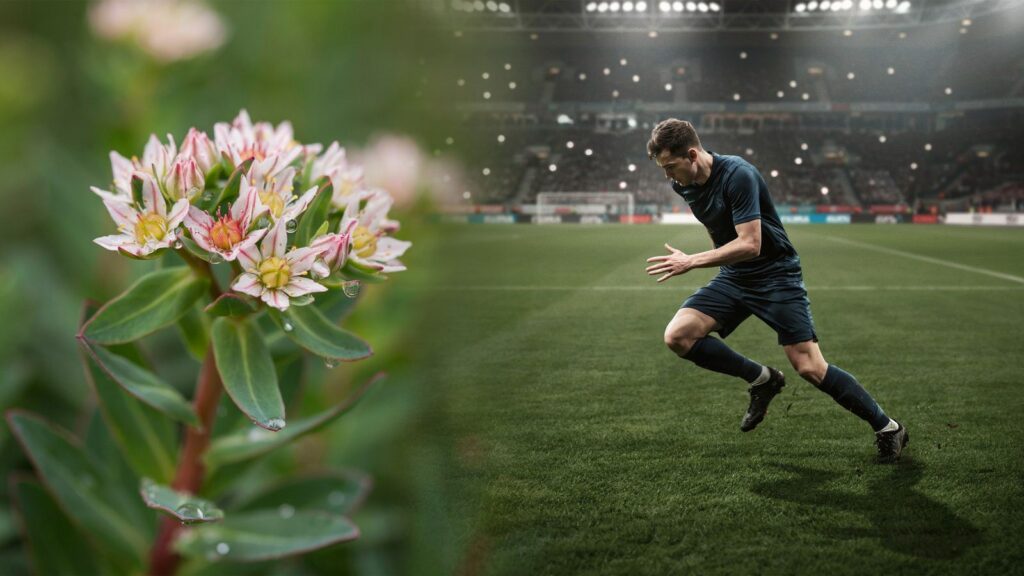
Football rewards players who can still think clearly and sprint hard in the 85th minute — precisely when fatigue is at its worst. A 2026 randomised controlled trial published in the journal Nutrients set out to test whether a natural supplement, Rhodiola rosea, could help competitive players do exactly that: recover faster between hard efforts and make sharper decisions when tired. The results are among the more comprehensive looks yet at how a single supplement affects both the physical and cognitive sides of football performance together.
What Rhodiola Rosea Is
Rhodiola rosea is a herb long used in traditional medicine across cold-climate regions of Europe and Asia, classified as an “adaptogen” — a category of plant compounds studied for their potential to help the body cope with physical and mental stress. Modern sports-science interest in Rhodiola centres on two questions: does it improve physical recovery and output during repeated high-intensity efforts, and does it protect mental sharpness — reaction time, decision accuracy — when the body is fatigued. Football is an unusually demanding test case for both, since a 90-minute match combines repeated sprints, jumps, and changes of direction with the need for constant tactical decision-making under mounting physical stress.
How the Study Was Designed
Researchers recruited 24 male competitive football players for a four-week, randomised, double-blind, placebo-controlled trial — the gold-standard design for testing whether a supplement’s effects are real rather than a placebo response. Half the players received Rhodiola rosea, half received a placebo, and neither the players nor the researchers knew who received which until the trial ended. Before and after the four-week period, players completed an extensive battery of tests: the Yo-Yo Intermittent Recovery Test Level 2 (a demanding measure of high-intensity endurance capacity used widely in professional football), a repeated-sprint ability test, blood lactate measurements immediately after sprint exercise, countermovement jump height, foot-tapping speed, a video-based football decision-making task measuring reaction time and accuracy, and GPS-tracked running metrics during actual match play.
What the Results Showed
The findings were consistent across nearly every measure. Yo-Yo IR2 performance improved significantly in the Rhodiola group and was significantly better than the placebo group’s result. In the repeated-sprint test, average sprint time improved meaningfully in the Rhodiola group, though each player’s single fastest sprint didn’t differ between groups — suggesting the benefit was more about sustaining speed across repeated efforts than raw top-end speed. Blood lactate levels measured immediately, three, and five minutes after sprint exercise were all significantly lower in the Rhodiola group, a sign of more efficient recovery from high-intensity effort. Jump height and foot-tapping frequency both increased. During actual match scenarios tracked by GPS, players in the Rhodiola group covered more total and high-speed running distance, with more acceleration and deceleration actions, while sprint distance itself held steady.
Perhaps most interesting for a sport built on split-second decisions, the cognitive results moved in the same direction as the physical ones. Under fatigue, players taking Rhodiola reacted faster and made more accurate decisions on the video-based task than the placebo group. Passing and shooting technical performance also improved from before to after the intervention in the Rhodiola group, with a clear advantage over placebo specifically in short-passing accuracy. Haemoglobin and haematocrit — markers related to the blood’s oxygen-carrying capacity — increased as well, offering a possible physiological explanation for the broader pattern of improved endurance and recovery.
Why This Matters Beyond the Lab
What makes this trial notable is that it measured physical output and cognitive performance together, in the same players, under the same fatigue conditions — rather than studying them in isolation as most supplement research does. Football, more than most sports, punishes a gap between the two: a tired player who can still sprint but can no longer read the game accurately is just as much a liability as one who can think clearly but has nothing physically left to give. The consistent improvement across both domains in this trial is what distinguishes it from typical single-outcome supplement studies.
It’s worth placing this finding in context. Related research on Rhodiola combined with caffeine in volleyball players has similarly found improvements in explosive power and fatigue recovery, suggesting the broader pattern of benefit isn’t limited to football specifically. As with any supplement research, a single trial of 24 players — while well-designed — is a meaningful first step rather than a final word, and effects can vary between individuals, sports, and training contexts.
Practical Takeaways
- The evidence is specific to trained athletes: this trial studied competitive football players already training regularly, not sedentary individuals, so the results speak most directly to that population.
- Four weeks was the tested window: the benefits emerged after a full month of consistent supplementation, not immediately — this isn’t a same-day pre-workout effect.
- Recovery, not just raw power, improved most: the clearest gains were in sustaining performance across repeated efforts and recovering between them, rather than a single maximal sprint or jump.
- Consult a professional before starting any supplement: individual response varies, and anyone considering Rhodiola rosea — particularly athletes subject to anti-doping testing — should discuss it with a doctor or sports nutritionist first.
Supplements are never a substitute for proper training, nutrition, and recovery — but findings like these point to a genuinely interesting avenue in sports science: substances that support both the muscles and the mind under the exact conditions that decide football matches, the tired final minutes when both physical and mental performance usually fade together.
Sources
- Effects of Rhodiola rosea on Physical and Decision-Making Performance in Football Players: A Randomised Controlled Trial — Nutrients (2026)
- Effects of Combined Rhodiola Rosea and Caffeine Supplementation on Lower Limb Explosive Power in Volleyball Players
The information in this article is for educational purposes only and does not substitute professional medical or sports nutrition advice. Consult a qualified professional before starting any new supplement.
The Active Arabia weekly
One article built on one named study, every week, in your inbox. No noise.
We never share your email. Unsubscribe in one click.