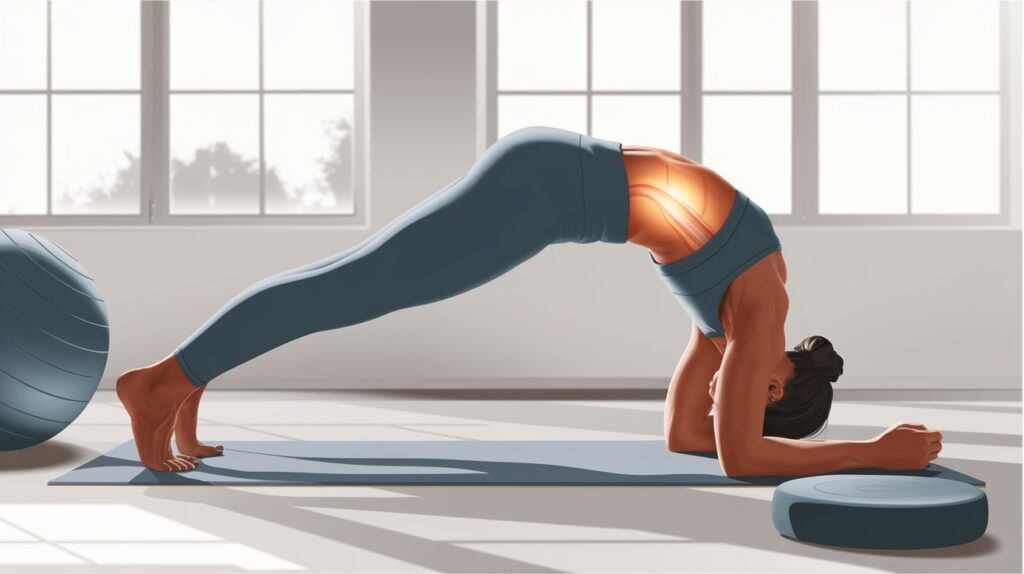
Core stability exercises are among the most evidence-backed tools for reducing chronic lower back pain and improving functional balance, according to a 2025 meta-analysis of 57 randomised controlled trials involving 7,705 participants published in Frontiers in Physiology. With lower back pain affecting an estimated 619 million people globally and projected to reach 810 million by 2050, understanding how core stability exercises can help is more relevant than ever — particularly for adults in Saudi Arabia, where sedentary lifestyles and desk-based work contribute to rising rates of musculoskeletal complaints.
What Core Stability Exercises Actually Do
The core is not a single muscle but an integrated system comprising the transverse abdominis, multifidus, internal and external obliques, pelvic floor, and diaphragm. Together, these muscles stabilise the spine, control pelvic alignment, and transfer force between the upper and lower body. When this system functions properly, the spine is protected from excessive shear and compressive loads. When it weakens — through inactivity, prolonged sitting, or age-related changes — the result is often compensatory movement patterns that place stress on the lumbar joints and ligaments.
This type of training specifically targets the deep stabilising muscles rather than the superficial movers like the rectus abdominis. The goal is to restore neuromuscular control: training the brain to recruit the right muscles at the right time during everyday movements. Research from the University of Parma’s systematic review of 49 studies confirmed that this targeted approach increases the thickness and activation of the transverse abdominis and lumbar multifidus — the two muscles most consistently linked to spinal protection.
What the Evidence Shows About Core Stability Exercises and Back Pain
The 2025 meta-analysis by Guo and colleagues, which pooled data from 57 randomised trials, found that all forms of core training — including core stability exercises, Pilates, and core resistance training — produced statistically significant reductions in pain intensity compared to control groups (standardised mean difference [SMD] = 0.70; 95% CI: 0.58–0.82; p < 0.00001). Core stability training specifically showed a moderate but significant effect (SMD = 0.53; 95% CI: 0.34–0.73), with the advantage of low heterogeneity across studies, meaning the results are consistent and reliable.
For functional disability — the degree to which back pain limits daily activities — this approach also delivered measurable improvements (SMD = 0.52; 95% CI: 0.33–0.70). The Parma review further documented that patients who completed core stability programmes showed increased muscle thickness in the transverse abdominis and multifidus, measurable improvements in pain thresholds, and elevated plasma beta-endorphin levels, suggesting a biochemical mechanism for the pain-relieving effect beyond simple strengthening.
Importantly, the meta-analysis found no statistically significant difference between the three training modalities for pain or function (p = 0.24), meaning that the “best” approach is the one a person can sustain consistently. This is practical news: whether you prefer mat-based stability work, resistance exercises, or Pilates, the evidence supports all three.
Core Stability Exercises for Athletic Performance
Beyond clinical populations, a 2025 systematic review in Frontiers in Sports and Active Living examined seven controlled trials in competitive athletes and found that core training improved trunk extensor strength, dynamic balance (measured by the Star Excursion Balance Test), and short-distance sprint speed (10–20 metres). One study of young soccer players showed a 3.6% improvement in 10–20 m sprint times after nine weeks of core strength training. Another found that handball players improved throwing velocity by 4.5% in men and 4.9% in women after a six-to-ten-week progressive core programme.
However, the same review noted that agility and jump height did not consistently improve, suggesting that core training transfers most directly to tasks requiring trunk stability and force transmission — not to every athletic variable. For recreational exercisers in Saudi Arabia, this means that building a strong core supports functional fitness and injury resilience more than it guarantees a faster sprint or higher jump.
How to Start Core Stability Exercises Safely
The evidence points to clear parameters for effective core training. The meta-analysis recommended 3–4 sessions per week, 45–60 minutes per session, over 6–8 weeks for optimal results. For beginners, a more gradual approach is sensible:
- Start with two to three sessions per week of 20–30 minutes, focusing on form over intensity.
- Include foundational movements: the dead bug, bird dog, front plank (hold 20–30 seconds), side plank, and glute bridge. Each targets a different component of the core system.
- Progress slowly: increase hold times by 5–10 seconds per week, or add one repetition per set.
- If you have existing back pain, consult a physiotherapist before starting. The research shows this approach is effective for chronic non-specific low back pain, but acute or specific causes require medical evaluation first.
- Combine stability work with general physical activity. Walking, swimming, and resistance training all complement these exercises.
Limitations and Honest Caveats
The evidence base, while substantial, has limitations. Many of the included trials had small sample sizes (often 20–50 participants), short follow-up periods (typically 4–12 weeks), and lacked long-term data beyond the intervention. The meta-analysis also noted that all three core training modalities showed limited effects on the mental health components of quality of life, meaning that while pain and function improve, broader psychological benefits are less certain. Additionally, most studies were conducted in clinical or university settings, and adherence in unsupervised real-world settings may differ.
For readers interested in how other evidence-based training methods support long-term strength and health, research on grip strength as a longevity predictor offers complementary insights into functional fitness assessment.
Sources
- Guo XB, Lan Q, Ding J, Tang L, Yang M. “Effects of different types of core training on pain and functional status in patients with chronic nonspecific low back pain: a systematic review and meta-analysis.” Frontiers in Physiology, 2025. https://doi.org/10.3389/fphys.2025.1672010
- Frizziero A, Pellizzon G, Vittadini F, Bigliardi D, Costantino C. “Efficacy of Core Stability in Non-Specific Chronic Low Back Pain.” Journal of Functional Morphology and Kinesiology, 2021. https://doi.org/10.3390/jfmk6020037
- Bustos Carvajal JS, Arias Coronel FA. “Exploring the role of the core in sports performance: a systematic review of the effects of core muscle training.” Frontiers in Sports and Active Living, 2025. https://doi.org/10.3389/fspor.2025.1630584
The information in this article is for educational purposes only and does not substitute professional medical advice. Consult a qualified healthcare provider before beginning any exercise programme, especially if you have existing health conditions.
The Active Arabia weekly
One article built on one named study, every week, in your inbox. No noise.
We never share your email. Unsubscribe in one click.