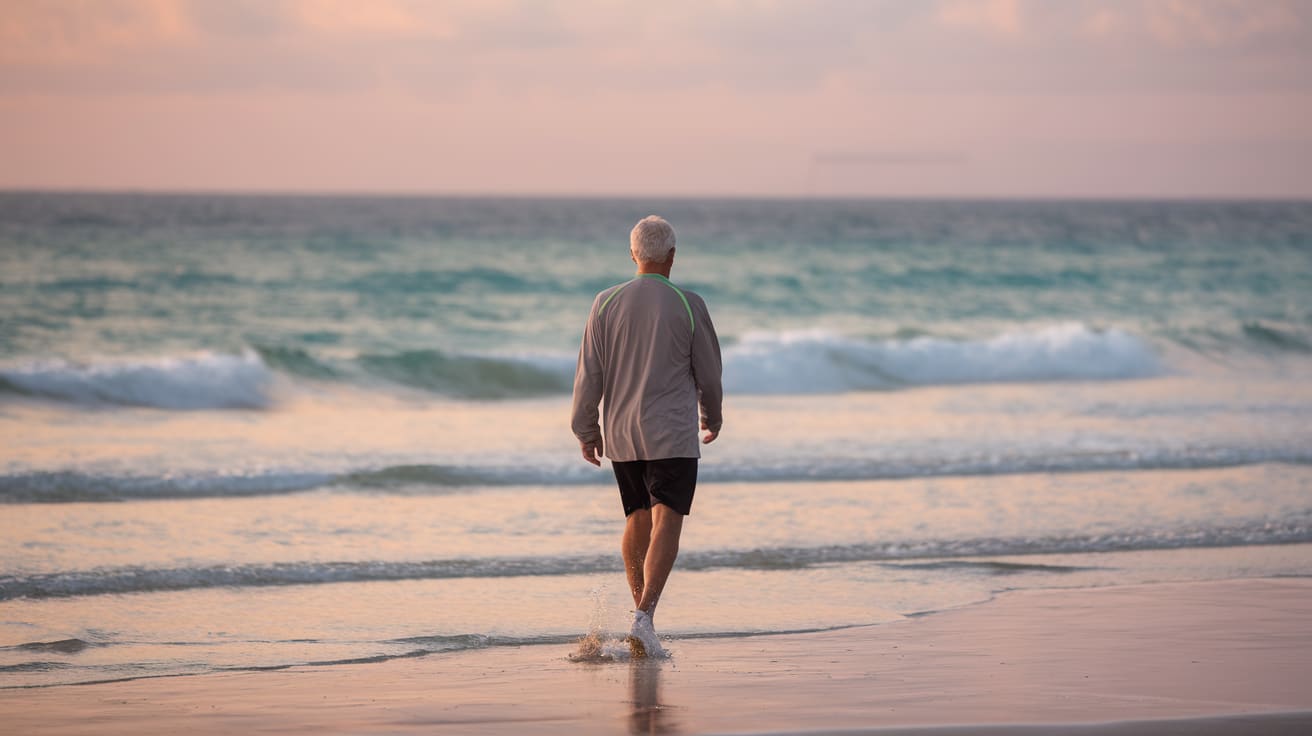
When 45 men aged 55-71 fasted during Ramadan, researchers studied ramadan fasting muscle health and expected to see decline. Instead, they found improved walking speed, better physical performance, reduced body fat, and healthier nerve-muscle communication. The 2026 study from the University of Sharjah challenges assumptions about fasting and muscle health in older adults.
What the Study Measured
Ramadan fasting muscle health was the focus of a prospective study led by Dr. Qaisar and colleagues at the University of Sharjah. The research team assessed body composition, handgrip strength, and a standardized physical performance battery before Ramadan, at one week and three weeks into fasting, and one week after Eid.
But the researchers went beyond typical fitness metrics. They measured plasma markers of neuromuscular junction integrity — the critical connection point where nerves communicate with muscles. Specifically, they tracked C-terminal agrin fragment-22 (CAF22), a marker of junction degradation, neurofilament light chain (NfL), indicating neuronal injury, and brain-derived neurotrophic factor (BDNF), which supports nerve health and plasticity.
The study design allowed the team to observe changes across the entire fasting period, not just before-and-after snapshots. This temporal resolution revealed something unexpected: the body’s response to Ramadan fasting is more nuanced than simple muscle preservation or loss.
Key Findings: Improved Walking Speed and Physical Performance
The most striking finding was improvements in gait speed and total short physical performance battery (SPPB) scores at post-Ramadan compared to pre-Ramadan (all p < 0.05). Gait speed is a powerful predictor of functional independence in older adults — slower walking speed correlates with higher risks of falls, hospitalization, and mortality.
Body fat also decreased significantly by the end of Ramadan. This combination — reduced fat mass with maintained or improved physical function — suggests that Ramadan fasting, when practiced without severe caloric restriction during non-fasting hours, may support favorable body composition changes even in older populations.
Handgrip strength and skeletal muscle index remained unchanged throughout the study. This is important: the fasting period did not cause measurable muscle atrophy, despite altered eating schedules and potential dehydration. The stability of these markers indicates that muscle mass was preserved, even as other aspects of physical capacity improved.
The Neuromuscular Junction Connection
Perhaps the most novel contribution of this research is the biomarker data. CAF22 levels — indicating neuromuscular junction degradation — decreased at one week, three weeks, and post-Ramadan. Simultaneously, BDNF increased across all measurement points, while NfL (neuronal injury marker) decreased at the three-week mark.
Multiple regression analysis revealed that the reduction in CAF22 correlated significantly with improvements in handgrip strength and total SPPB scores at one week and post-Ramadan. This suggests that neuromuscular junction restoration may be associated with enhanced physical capacity during Ramadan fasting.
The neuromuscular junction is where motor neurons transmit signals to muscle fibers, triggering contraction. Age-related degradation of these junctions contributes to sarcopenia and functional decline. The observed improvements in CAF22 — a fragment released when agrin, a protein critical for junction maintenance, is broken down — hint at reduced degradation or enhanced repair of these vital connections.
BDNF supports the survival and growth of neurons, including motor neurons. The increase in BDNF during Ramadan fasting aligns with emerging evidence that intermittent fasting patterns may upregulate neurotrophic factors, potentially through metabolic switching and reduced oxidative stress.
Does Ramadan Fasting Cause Muscle Loss?
A common concern is that fasting and metabolic health during Ramadan leads to muscle catabolism. The evidence, however, is more complex. A 2025 systematic review published in Clinical Nutrition ESPEN examined 31 studies on Ramadan intermittent fasting and physical performance across different sports.
The review found that performance decrements were most pronounced in team sports requiring repeated high-intensity efforts — handball, basketball, volleyball, football, and swimming. Tennis, badminton, martial arts, and endurance sports showed less negative impact. Crucially, athletes who maintained total energy intake, macronutrient distribution, training load, body composition, and sleep quality were unlikely to suffer substantial performance declines.
This suggests that muscle loss during Ramadan is not inevitable but context-dependent. When fasting is accompanied by adequate nutrition during non-fasting hours and appropriate training adjustments, muscle preservation — and even functional improvement — is achievable.
Training During Ramadan: What Athletes Should Know
A 2025 study in Sports Medicine — Open provides practical guidance. Researchers assigned 40 highly-trained male youth soccer players to either neuromuscular training or traditional soccer-specific training during Ramadan. Both groups trained twice weekly for four weeks with matched volume.
The neuromuscular training group — incorporating strength, plyometrics, speed, and balance exercises — showed significant improvements in sprint speed, change-of-direction ability, jump performance, and isokinetic strength. The traditional training group did not. Injury rates were also significantly lower in the neuromuscular group (8.00 vs 13.33 per 1,000 hours of exposure).
These findings demonstrate that strategic training during Ramadan can not only maintain but improve physical fitness. The key is adapting training content to the altered physiological context of fasting — emphasizing quality over quantity, prioritizing recovery, and focusing on neuromuscular qualities that respond well to lower-volume, higher-intensity stimulus.
Practical Tips for Maintaining Muscle Health During Ramadan
- Prioritize protein intake during non-fasting hours — aim for 1.6-2.0 grams per kilogram body weight distributed across 2-3 meals to support muscle protein synthesis
- Time training sessions strategically — either 1-2 hours before iftar when you can refuel immediately, or 2-3 hours after iftar when hydrated and fueled
- Focus on compound movements and neuromuscular exercises — squats, deadlifts, lunges, plyometrics — that stimulate multiple muscle groups and maintain coordination
- Maintain hydration between iftar and suhoor — dehydration impairs performance and recovery, even if muscle mass is preserved
- Protect sleep quality — disrupted sleep patterns during Ramadan can elevate cortisol and impair recovery; aim for consistent sleep windows even if total duration is reduced
- Monitor body composition if possible — tracking changes in body fat and muscle mass helps you adjust nutrition and training in real time
Limitations and Context
The Qaisar study had important limitations. The sample size was modest (n=45), all participants were male, and the age range was narrow (55-71). The study did not include a control group of non-fasting individuals, so changes cannot be definitively attributed to fasting rather than other seasonal or lifestyle factors.
The biomarker findings, while statistically significant, require replication in larger, more diverse populations. The mechanisms linking Ramadan fasting to neuromuscular junction improvements remain speculative — the study demonstrated correlation, not causation.
Additionally, the study was conducted in older men with no reported chronic conditions. Results may differ in younger populations, women, or individuals with metabolic diseases. The generalizability to athletes or highly active individuals is also uncertain.
Sources
Qaisar R, Khan IU, Iqbal MS, et al. “Effects of Ramadan fasting on physical capacity and plasma markers of neuromuscular junction degradation in older adult men.” European Journal of Nutrition. 2026;65(1):30. doi:10.1007/s00394-025-03890-9.
Ghaffar T, Ubaldi F, Valeriani F, Romano Spica V. “A review of the impact of intermittent ramadan fasting on wellbeing, nutrition and physical performance in different sports.” Clinical Nutrition ESPEN. 2025;67:585-598. doi:10.1016/j.clnesp.2025.03.052.
Belamjahad A, Tourny C, Hackney AC, et al. “Effects of Neuromuscular Training Applied During Ramadan on Physical Fitness and Injury Prevention in Highly-Trained Male Youth Soccer Players.” Sports Medicine — Open. 2025;11(1):34. doi:10.1186/s40798-025-00831-y.
The Active Arabia weekly
One article built on one named study, every week, in your inbox. No noise.
We never share your email. Unsubscribe in one click.